
Video and Social Media Performance at a Surgical Journal With Video Journal Clubs
Abstract
Caden Seraphine,1 Abigail Chambers,1 Susan Galandiuk2
Objective
In recent years, Diseases of the Colon & Rectum (DCR), a single society-owned specialty journal, sought to grow its online presence. The journal launched a YouTube channel in 2018, featuring videos of monthly English-language journal clubs (JCs) discussing topical publications beginning in 2020, followed by article discussions in Spanish (2022-2023), Japanese (2024), and Korean (2024). The journal maintained its Facebook and X (formerly Twitter) presence and started LinkedIn and Instagram accounts in 2023. Articles were given a nonpaywalled status for 1 month, and upcoming discussions with article hyperlinks were announced 4 times per month via social media. Articles were accessible by hyperlinks, and article citations were displayed in JC discussant slides. We sought to explore how these activities impacted measures of journal interaction and global reach.1,2
Design
We performed a 7-year (2018-2024) retrospective cohort study of JC video-based educational content provided by DCR with respect to journal website and social media access following STROBE guidelines.3 We examined efforts toward global engagement, including addition of journal-specific non–English-language (2 Spanish, 1 Korean, and 1 Japanese) discussions. Analyses of 4 popular social media platforms’ native analytics reporting and website engagement data examined viewer demographics (age, language, viewing country, and traffic source) and journal web-based interaction (number of views, number of unique visitors, and country of access) by month and year, trends in individual JC videos, and overall page engagement. We compared the median number of citations of JC articles (cumulative Web of Science citations) and their Altmetric scores (indicating article attention received) with mean citations of DCR articles per year.
Results
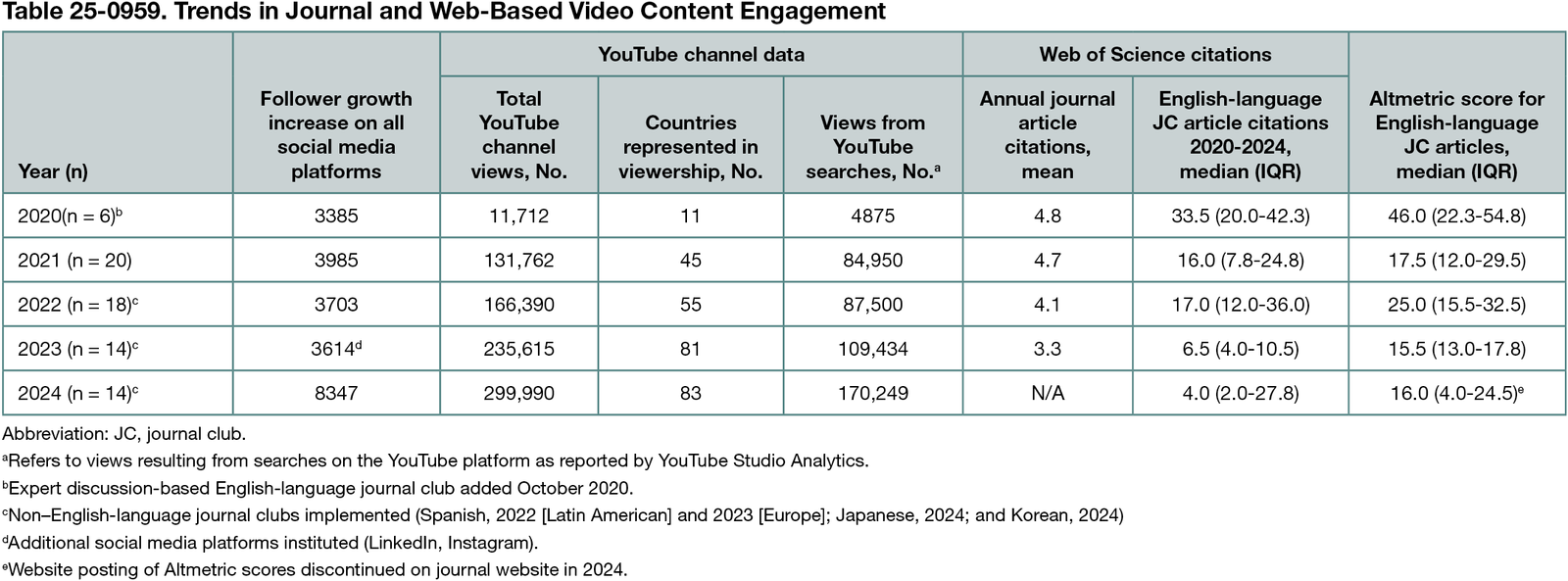
Only 1 JC featured videos of surgical procedures; all others discussed original articles. The growth in YouTube engagement since the journal’s YouTube channel launched in 2018 grew exponentially with the addition of monthly JCs in 2020. LinkedIn and Instagram were implemented in 2023, and cumulative traffic to the journal’s website from social media platforms tripled within 1 year, from 15,414 clicks in 2023 to 56,609 in 2024 (Facebook, X, Instagram, LinkedIn, and YouTube). Throughout the period, individuals aged 25 to 34 years led YouTube viewership. International engagement increased with DCR’s implementation of non-English JC discussions in 2022. Publications discussed during JCs consistently had higher Web of Science citations compared with the mean citations in the journal that year (Table 25-0959).
Conclusions
Younger audiences engage beyond traditional platforms of scholarly publishing in ways that hold inherent educational value. Journal Impact Factors exclude this reach and overlook the impact of web-based peer-reviewed educational content. Inclusion of social media and video-based learning tools, as well as efforts toward global reach, contribute to journal impact.
References
1. Narayan RR, Fleming AM, Gunder M, et al. Reflections from the Annals of Surgical Oncology social media committee: the impact of promoting surgical science online. Ann Surg Oncol. 2025;32(2):656-664. doi:10.1245/s10434-024-16420-4
2. Özkent Y. Social media usage to share information in communication journals: an analysis of social media activity and article citations. PLoS One. 2022;17(2):e0263725. doi:10.1371/journal.pone.0263725
3. von Elm E, Altman DG, Egger M, Pocock SJ, Gøtzsche PC, Vandenbroucke JP; STROBE Initiative. The Strengthening the Reporting of Observational Studies in Epidemiology (STROBE) statement: guidelines for reporting observational studies. J Clin Epidemiol. 2008;61(4):344-349. doi:10.1016/j.jclinepi.2007.11.008
1Price Institute of Surgical Research, University of Louisville, Louisville, KY, US; 2Division of Colorectal Surgery, Department of Surgery, University of Louisville, Louisville, KY, US, s0gala01@louisville.edu.
Conflict of Interest Disclosures
Susan Galandiuk receives a stipend for services as editor for the journal Diseases of the Colon & Rectum from the American Society of Colon and Rectal Surgeons. No other disclosures were reported.
Acknowledgments
Margaret Abby (Managing Editor, Diseases of the Colon & Rectum; Research Grants Coordinator, Department of Surgery, University of Louisville, Louisville, KY), helped with obtaining data on articles discussed during journal clubs and their Web of Science citations.