
Topic and Knowledge-Base Interdisciplinarity in Manuscripts Submitted to Physical Science Journals vs Editorial Decision and Reviewer Positivity
Abstract
Sidney Xiang,1 Daniel M. Romero,1,2,3 Misha Teplitskiy1
Objective
Prior literature on interdisciplinary research evaluation does not include prepublication manuscripts or account for differential evaluation over multiple dimensions of interdisciplinarity. Based on management science literature, we introduce 2 novel dimensions: topic interdisciplinarity, which may incur evaluation penalties by cutting across disciplinary standards and threatening symbolic boundaries, and knowledge-base interdisciplinarity, which may incur benefits by combining larger pools of nonredundant information. Evaluations may also depend on how these dimensions align with each other and the audience. Our study tested these hypotheses using a large-scale dataset of journal submissions.
Design
We performed a case-control study using administrative data from the Institute of Physics Publishing, a major STEM publisher. The data included 128,950 manuscripts (accepted and rejected) submitted to 62 physical science journals from 2018 to 2022. We calculated topic interdisciplinarity with concept tags of the manuscript’s associated OpenAlex record1 and knowledge-base interdisciplinarity with concept tags of the manuscript’s references. For each type, we quantified interdisciplinarity using the integration index,2 ranging from 0 to 1. Logistic regression was used to model the relationship between both types of interdisciplinarity and 2 evaluation outcomes: final decision and review positivity, controlling for journal, manuscript type, year, number of authors, number of authors’ prior citations, number of authors’ prior publications, and number of references. We retained observations with both interdisciplinarities and all covariates.
Results
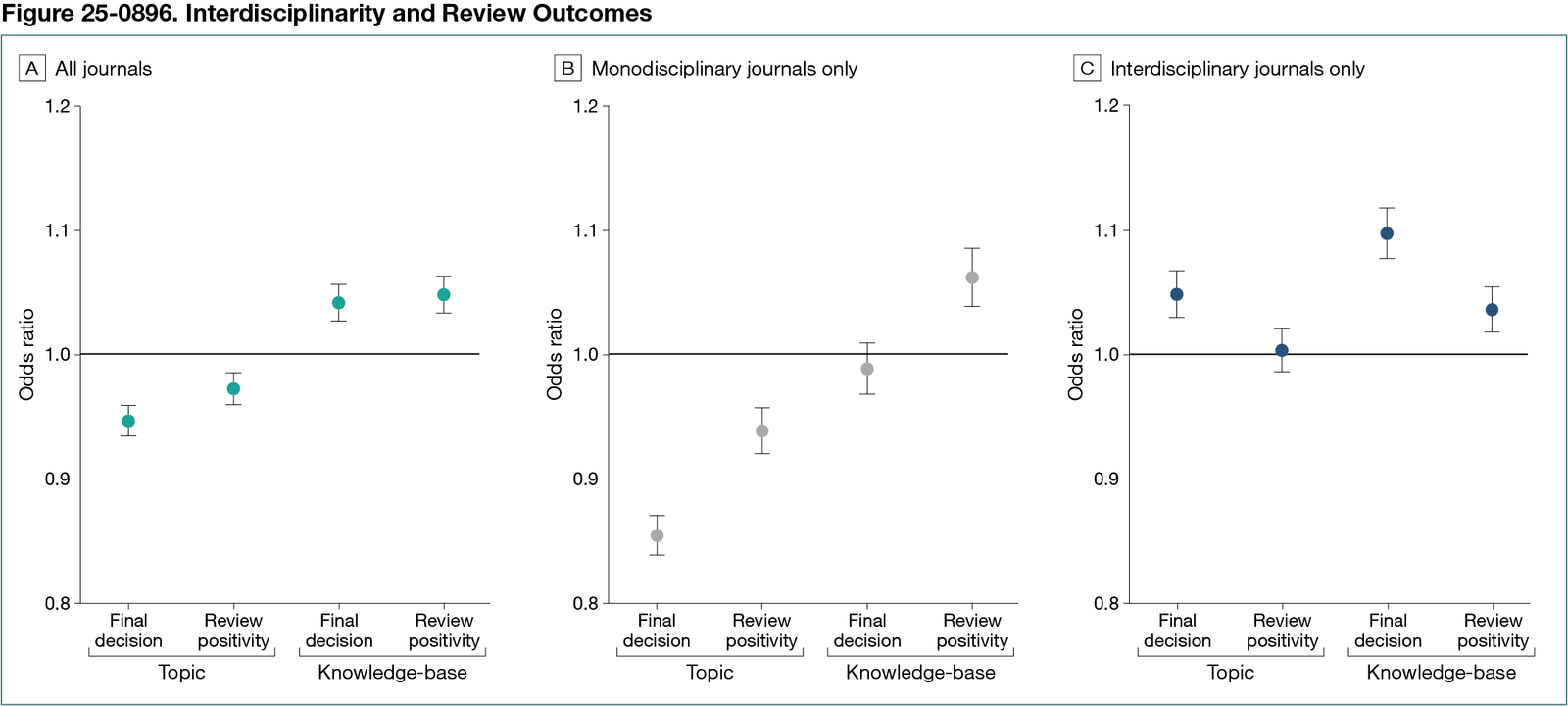
The marginal effect of a 1-SD increase in knowledge-base interdisciplinarity was a 0.9 (0.7) percentage point higher acceptance (positive review) probability, while a 1-SD increase in topic interdisciplinarity corresponded to a 1.2 (0.4) percentage point lower acceptance (positive review) probability. Interactions revealed that high knowledge-base interdisciplinarity attenuated the negative relationship between topic interdisciplinarity and acceptance. We did not see a symmetric effect when high knowledge-base interdisciplinarity was accompanied by high topic interdisciplinarity. When disaggregating model results by journal interdisciplinarity according to the publisher’s 2022 product catalogue,3 journals categorized by the publisher as interdisciplinary or multisubject had positive associations between both types of interdisciplinarity and evaluation outcomes, whereas monodisciplinary journals had negative associations. Our results were robust to the inclusion and transformation of manuscript and team covariates.
Conclusions
Our findings indicate that different dimensions of interdisciplinarity have different relationships to evaluation and that, for successful publication, authors must attend to alignment between types of interdisciplinarity within the manuscript and between the manuscript and journal audience. Limitations include the scope of journals in our dataset (STEM only) and the reliance on matching submissions to OpenAlex records.
References
1. Priem J, Piwowar H, Orr R. OpenAlex: a fully-open index of scholarly works, authors, venues, institutions, and concepts. arXiv. Preprint posted online May 4, 2022. doi:10.48550/ARXIV.2205.01833
2. Porter AL, Cohen AS, David Roessner J, Perreault M. Measuring researcher interdisciplinarity. Scientometrics. 2007;72(1):117-147. doi:10.1007/s11192-007-1700-5
3. IOP Publishing. Product catalogue 2022. https://ioppublishing.org/wp-content/uploads/2022/03/IOPP-Catalogue-2022.pdf
1University of Michigan School of Information, Ann Arbor, MI, US, tepl@umich.edu; 2University of Michigan Department of Electrical Engineering and Computer Science, Ann Arbor, MI, US; 3University of Michigan Center for the Study of Complex Systems, Ann Arbor, MI, US.
Conflict of Interest Disclosures
None reported.