
Review and Publication Times Across Journals Publishing on Health Policy
Abstract
Kathryn A. Phillips,1,2 Danea M. Horn1,2
Objective
The move toward open science has focused attention on journal review and publication times,1 particularly for health care research, where rapid dissemination is important for decision-making. We examined how academic journals that publish on health policy report and measure their review and publication times (RPTs) and assessed patterns across journals. Compared with earlier research that focused on article-level metrics for specialty journals,2 we focused on journal-level metrics across a broad range of journals, enhancing generalizability.
Design
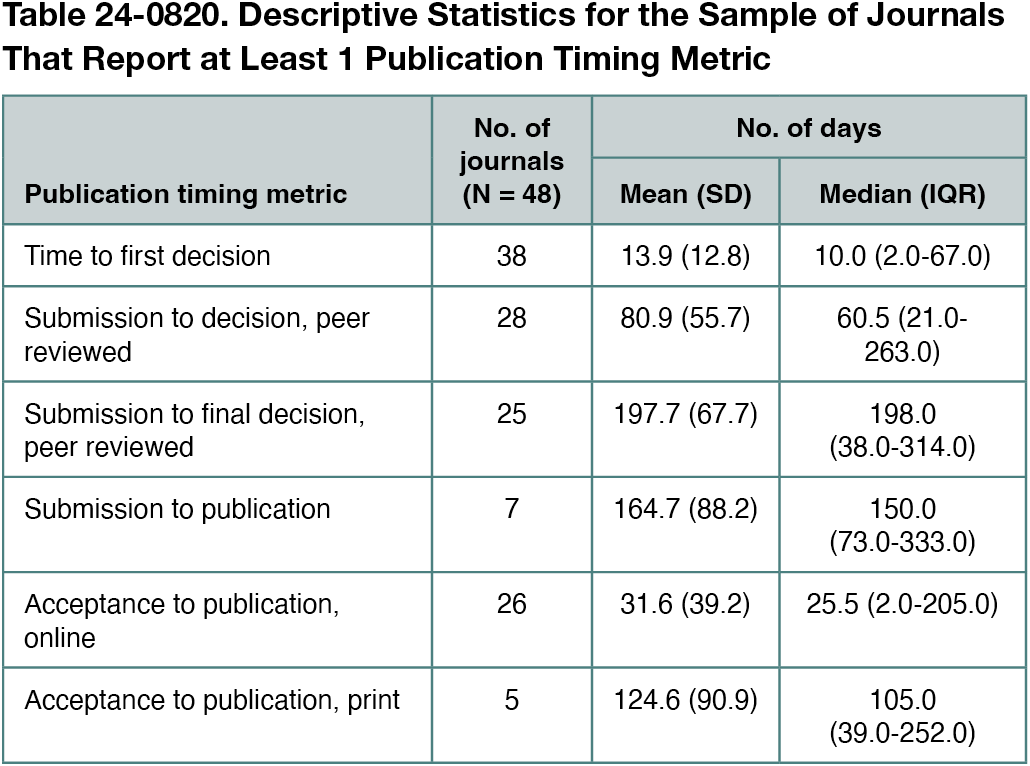
We conducted a cross-sectional analysis of 57 academic journals that publish on health policy topics following STROBE guidelines. Institutional review board review was not required. We included journals with a Google h5-index greater than 23 and a Clarivate impact factor of 2 or higher as of November 18, 2024. Final inclusion was based on review by 3 journal editors. We examined 6 metrics (Table 24-0820) and used descriptive and statistical analyses to assess variation in the definition and reporting of RPTs. We compared RPTs across journal characteristics using the Wilcoxon rank sum test (with significance established at P < .05).
Results
Of the 57 journals analyzed, 9 (15.8%) did not publicly report any RPTs. Conversely, only 21 journals (36.8%) reported 3 or more metrics. There was wide variation in each reported RPT, with the full peer-reviewed publication process taking 5.6 to 11.9 months. Open access journals had faster median submission to final decision (peer-reviewed) times compared with hybrid and subscription journals (184.5 vs 228.0 days; P = .03). Highly selective journals (journals with high impact factors and low acceptance rates) had a faster median time to first decision than less selective journals (3.0 vs 13.0 days; P < .001). Within each RPT metric, there was considerable variation in reporting frequency and definitions. Journals often did not clarify whether the time to first decision included peer review and presented ranges or used qualifiers such as typically or approximately for post–peer review decision times. Few journals reported metrics by article type or provided metric time frames. Lastly, mean and median were used inconsistently.
Conclusions
There was substantial variation across journals in whether and how they report RPTs and selective reporting and considerable variation in how timing metrics were defined. Publication speed is influenced by multiple factors, including review processes and publication frequency. The lack of standardized reporting practices limits transparency in academic publishing and suggests a need for journals to more consistently report RPTs and for RPTs to be included in standardized databases and tracking systems. This would better inform author submission decisions and inform future research and testing of RPT interventions using data from editorial systems. Improving reporting and transparency is especially important for research on urgent health policy topics and for early-career academics.3
References
1. Phillips KA. Open access publication at a crossroads—implications for researchers and beyond. JAMA Health Forum. 2024;5(10):e242914. doi:10.1001/jamahealthforum.2024.2914
2. Petrou C. Guest post—publishing fast and slow: a review of publishing speed in the last decade. The Scholarly Kitchen. November 8, 2022. Accessed November 8, 2024. https://scholarlykitchen.sspnet.org/2022/11/08/guest-post-publishing-fast-and-slow-a-review-of-publishing-speed-in-the-last-decade/
3. Andersen MZ, Fonnes S, Rosenberg J. Time from submission to publication varied widely for biomedical journals: a systematic review. Curr Med Res Opin. 2021;37(6):985-993. doi:10.1080/03007995.2021.1905622
1Center for Translational and Policy Research on Precision Medicine, Department of Clinical Pharmacy, University of California, San Francisco, CA, US, kathryn.phillips@ucsf.edu; 2Institute for Health Policy Studies, University of California, San Francisco, CA, US.
Conflict of Interest Disclosures
Kathryn A. Phillips is the founding editor in chief of Health Affairs Scholar: Emerging and Global Health Policy. No other conflicts were reported.
Funding/Support
This abstract was partially supported by Health Affairs and Project HOPE.
Role of the Funder/Sponsor
The funder had no role in the preparation, review, or approval of the abstract.