
Prevalence of and Reasons for Retractions of Traditional Chinese Medicine Research Publications by Authors From Mainland China in International Peer-Reviewed Journals
Abstract
Jing Cui,1 Nan Yang,1 Kexin Ji,1 Dingran Yin,1 Chen Shen,2 Zhaolan Liu,2 Han Tan,3 Yaxin Sun,4 Zhaoqi Huo,5 Shuo Liu,5 Huiyu Wang,5 Xintong Zhang,6 Jing Guo,1 Yufei Wang,7 Xiaoqi Ren,5 Vincent C. H. Chung,8 Jianping Liu2
Objective
Publication retractions, especially in the field of medicine, have long been a matter of significant concern.1 The trends and characteristics of retractions of publications on Traditional Chinese medicine (TCM) by authors from mainland China remain unclear. This study is dedicated to exploring the prevalence and underlying reasons of retractions in TCM publication.
Design
This cross-sectional study identified and analyzed publications that were marked as retractions or withdrawal. It encompassed retractions of TCM literature published by mainland Chinese authors in international peer-reviewed journals from January 2000 to November 2024. Seven medical databases were systematically searched, including 3 English-language databases (PubMed, Embase, and Cochrane Library) and 4 Chinese-language databases (China National Knowledge Infrastructure, Wanfang Data, VIP Database, SinoMed), as well as the Retraction Watch Database. Duplicate data were excluded. Article screening and data extraction were independently conducted by 2 authors. Discrepancies were resolved through discussion. The retractions of TCM publications by mainland Chinese authors were thoroughly analyzed. The numbers and characters of retractions across different study types were compared, and retraction reasons were comprehensively summarized according to Committee on Publication Ethics (COPE) guidelines. Main outcomes included the prevalence, reasons, and relevant factors of retraction (year, authors’ region and affiliation, study types, study subjects, and reasons).
Results
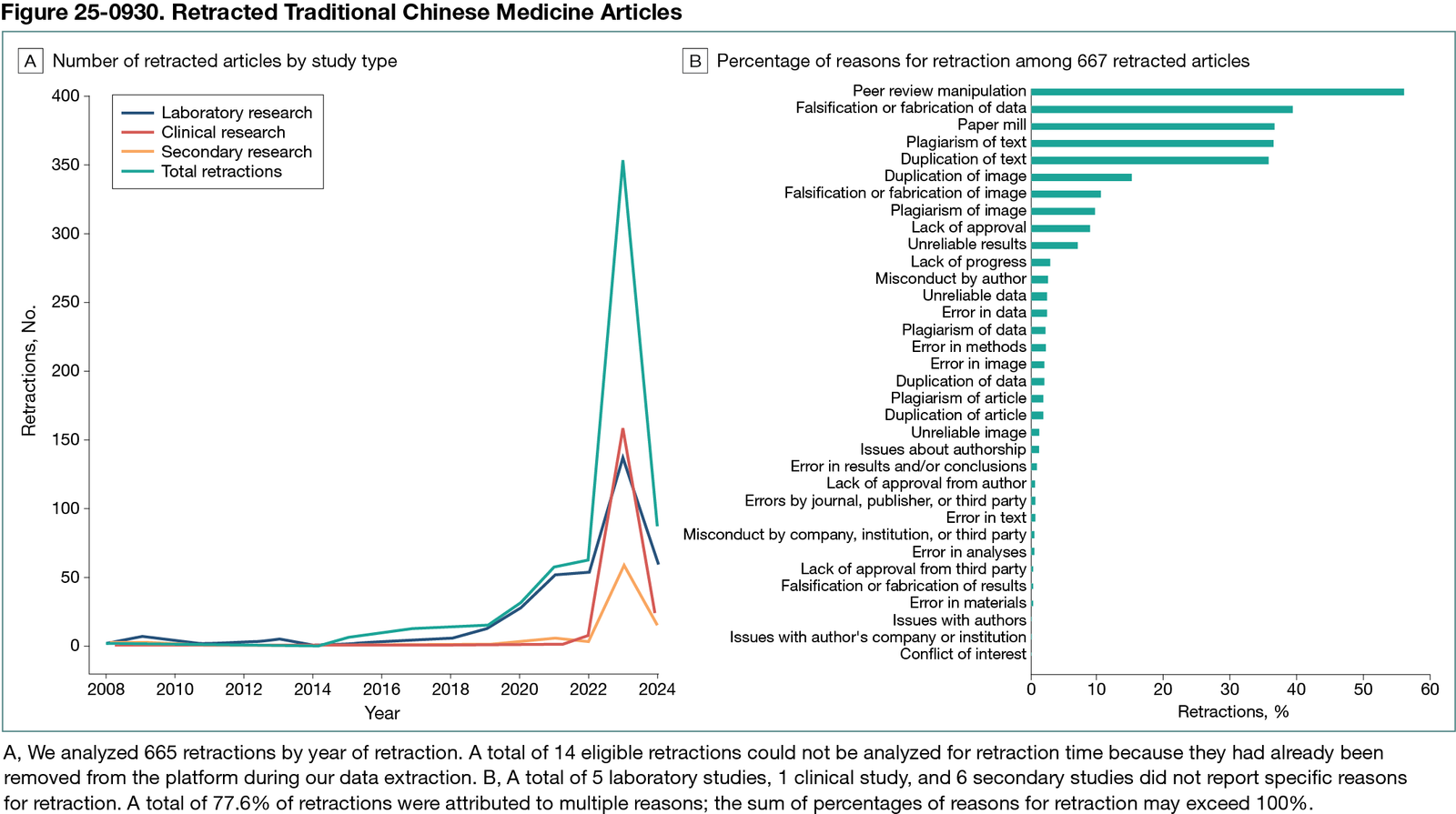
A total of 24,479 retracted articles were initially identified, and 679 retracted publications on TCM met inclusion criteria. Retractions encompassed laboratory studies (381 [56.1%]), clinical studies (189 [27.8%]), and secondary studies (109 [16.1%]). Notably, the number of retractions surged to 354 articles (52.1%) in 2023 (Figure 25-0930). Most first authors were affiliated with Grade A tertiary hospitals (the highest accreditation level in China’s health care system; 415 [61.1%]). Active-ingredient extracts of TCM (289 [42.6%]) and neoplasms (145 [22.6%]) emerged as the most prevalent study subjects. A total of 77.6% of retractions were attributed to multiple reasons, so that the sum of the percentage of reasons may exceed 100%. A total of 12 retracted articles had no specific reasons found. Author misconduct drove 576 retractions (86.4%), predominantly involving peer review manipulation (374 [56.1%]), falsification or fabrication of data (262 [39.3%]), and paper mills (244 [36.6%]).
Conclusions
Currently, retractions of TCM publications have become increasingly conspicuous, particularly those from higher-level academic institutions and hospitals. Systemic author misconduct, notably compromised peer review processes and industrialized fraud, may constitute the primary driver. However, some publishers regularly remove retracted literature from the platform, which results in omissions in the data. To promote scientific credibility in TCM publications, we recommend (1) enhanced institutional accountability mechanisms, (2) standardized retraction policies aligned with COPE guidelines, (3) mandatory research integrity training, and (4) transparent postretraction investigations.2
References
1. Else H. Biomedical paper retractions have quadrupled in 20 years—why? Nature. 2024;630(8016):280-281. doi:10.1038/d41586-024-01609-0
2. Bakker CJ, Reardon EE, Brown SJ, et al. Identification of retracted publications and completeness of retraction notices in public health. J Clin Epidemiol. 2024;173:111427. doi:10.1016/j.jclinepi.2024.111427
1Qi-Huang Chinese Medicine School, Beijing University of Chinese Medicine, Beijing, China; 2Centre for Evidence-Based Chinese Medicine, Beijing University of Chinese Medicine, Beijing, China, liujp@bucm.edu.cn; 3School of Acupuncture-Moxibustion and Tuina, Beijing University of Chinese Medicine, Beijing, China; 4School of Management, Beijing University of Chinese Medicine, Beijing, China; 5School of Traditional Chinese Medicine, Beijing University of Chinese Medicine, Beijing, China; 6School of Humanities, Beijing University of Chinese Medicine, Beijing, China; 7College of Continuing Education, Hebei University of Chinese Medicine, Shijiazhuang, China; 8Jockey Club School of Public Health and Primary Care, Faculty of Medicine, The Chinese University of Hong Kong, Hong Kong SAR, China.
Conflict of Interest Disclosures
None reported.
Funding/Support
High-level Traditional Chinese medicine key subjects construction project of National Administration of Traditional Chinese Medicine—Evidence-Based Traditional Chinese Medicine (award zyyzdxk-2023249).
Role of the Funder/Sponsor
The sponsor contributed to the decision to submit the abstract for presentation.
Additional Information
Jing Cui and Nan Yang contributed equally to this work, and Kexin Ji and Dingran Yin contributed equally to this work. Vincent C. H. Chung is a co–corresponding author (vchung@cuhk.edu.hk).