
Preprint Policies in Ecology and Evolutionary Biology Journals
Abstract
Marija Purgar,1,2 Edward R. Ivimey-Cook,3 Antica Culina,1,4 Joshua D. Wallach2,5
Objective
Preprints—preliminary research reports that have not yet undergone peer review—are becoming increasingly common across scientific fields.1 However, little is known about preprint policies in journals that publish ecology and evolutionary biology research.2
Design
In this cross-sectional analysis, we identified all journals included under the Web of Science 2023 Journal Citation Reports categories of Ecology and Evolutionary Biology. We reviewed journal and publisher websites to explore specific preprint policies, including guidelines regarding the possible locations for posting preprints (eg, on a preprint server), disclosure of preprints at time of manuscript submission and the required location (eg, in the cover letter), timing of preprint posting relative to manuscript submission (eg, before submission to a journal), and any additional actions on publication of the final article (eg, linking the preprint to the published version). The journal-level and publisher-level policies were classified as preprints allowed without restrictions, preprints considered on a case-by-case determination (manuscripts with preprints evaluated by the journal on an individual basis), or preprints prohibited. Journals with no identified policy were categorized as having no preprint policy. We used a Wilcoxon rank sum test to compare 2023 Journal Impact Factors between journals with a preprint policy at either journal- or publisher-level and those without any preprint policy.
Results
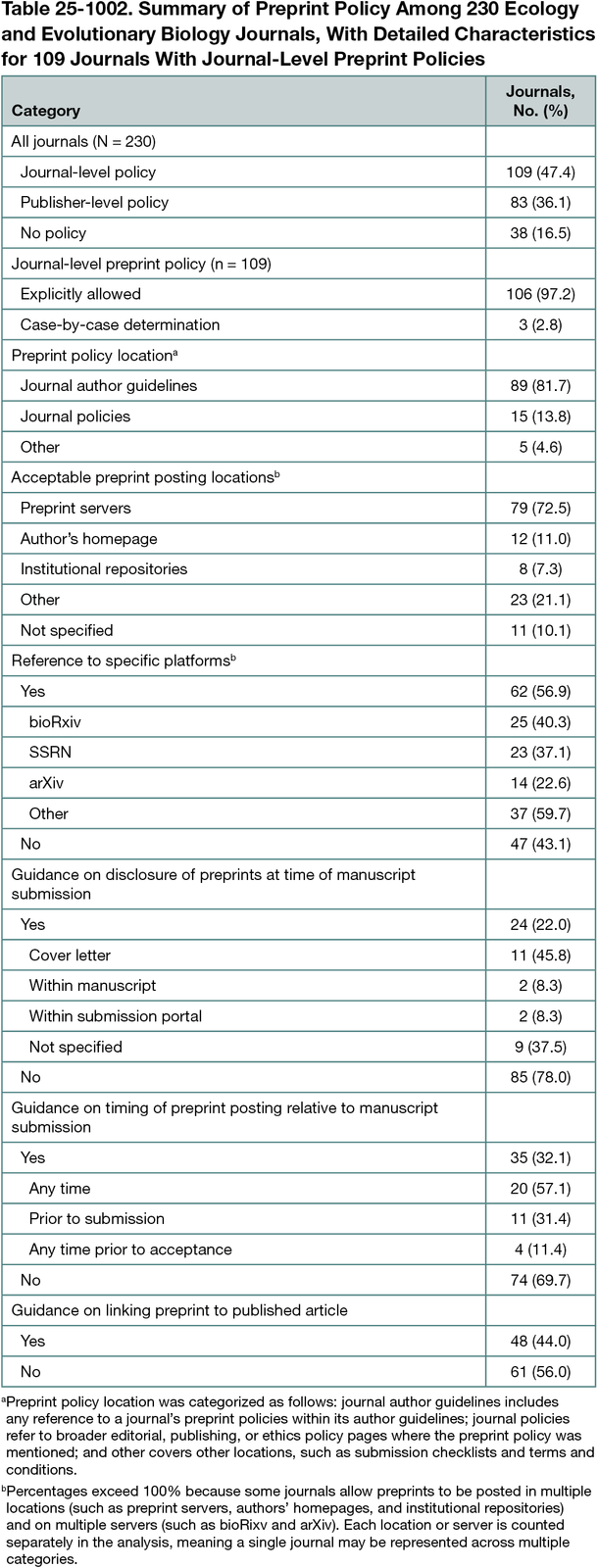
We identified 230 eligible ecology and evolutionary biology journals published by 69 different publishers, of which 119 (51.7%) included preprint policies in their author guidelines—either through journal-specific policies (n = 109) or by directly referencing their publisher’s preprint policies (n = 10). There were 73 additional journals (31.7%) without their own preprint policies, which did not directly reference their publisher’s preprint policies but were associated with publishers that had favorable policies. Overall, there were 38 journals (16.5%) without any journal-level or publisher-level preprint policies. Of the 192 journals with either journal-level or publisher-level preprint policies, 191 (99.5%) explicitly allowed preprints and 1 (0.5%) considered preprints on a case-by-case basis. The median (IQR) Journal Impact Factor was higher among journals with a journal-level or publisher-level preprint policy (2.4 [1.7-3.7]) compared with those without any preprint policy (0.6 [0.5-0.9]) (P < .001). Among the 109 journals with journal-level preprint policies (Table 25-1002), 62 (56.9%) provided information about specific platforms (eg, bioRxiv, SSRN, arXiv), 24 (22.0%) required disclosure of preprints during manuscript submission, and 35 (32.1%) provided specific guidance on the timing of preprint posting relative to manuscript submission.
Conclusions
In this study, only one-half of identified ecology and evolutionary biology journals provided preprint policies in their journal-level author guidelines or offered clear instructions regarding the use of preprints. This lack of clarity may lead to confusion among authors about whether posting a preprint before submitting to a peer-reviewed journal conflicts with the journal’s policies on prior publication.
References
1. Abdill RJ, Blekhman R. Meta-research: tracking the popularity and outcomes of all bioRxiv preprints. eLife. 2019;8:e45133. doi:10.7554/eLife.45133
2. Noble DW, Xirocostas ZA, Wu NC, et al. The promise of community-driven preprints in ecology and evolution. EcoEvoRxiv. Preprint posted online June 13, 2024. doi:10.32942/X2SS46
1Division for Marine and Environmental Research, Ruđer Bošković Institute, Zagreb, Croatia; 2Department of Epidemiology, Rollins School of Public Health, Emory University, Atlanta, GA, US, joshua.wallach@emory.edu; 3School of Biological Sciences, One Health & Veterinary Medicine, University of Glasgow, Scotland, UK; 4Netherlands Institute of Ecology, Royal Netherlands Academy of Arts and Sciences, Wageningen, the Netherlands; 5Collaboration for Regulatory Rigor, Integrity, and Transparency, Yale School of Medicine, New Haven, CT, US.
Conflict of Interest Disclosures
Marija Purgar, Edward R. Ivimey-Cook, and Antica Culina are members of the Society for Open, Reliable, and Transparent Ecology and Evolutionary Biology; Marija Purgar and Edward R. Ivimey-Cook are on the current Board of Directors. Joshua D. Wallach reports funding from Arnold Ventures to the Yale Collaboration for Regulatory Rigor, Integrity, and Transparency, the National Institute on Alcohol Abuse and Alcoholism of the National Institutes of Health under award 1K01AA028258, Johnson & Johnson (through the Yale Open Data Access Project), and the US Food and Drug Administration. No other disclosures were reported.
Funding/Support
Marija Purgar was funded by the Croatian Science Foundation project number DOK-2021-02-6688. Marija Purgar gratefully acknowledges the financial support for this research by the Fulbright US Student Program, which is sponsored by the US Department of State and the Croatian-American Fulbright Commission. Antica Culina was funded by the Croatian Science Foundation project number IP-2022-10-2872.
Additional Information
Marija Purgar is a co–corresponding author (mpurgar@irb.hr).