
Librarian and Information Specialist Perceptions of Peer Reviewing Systematic Reviews
Abstract
Melissa L. Rethlefsen,1 Carrie Price,2 Sara Schroter3
Objective
To explore the perspectives of librarians and information specialists (LISs) who participated in a randomized controlled trial of the effect of LIS involvement on reporting quality of systematic reviews (SRs).1
Design
We surveyed LISs who completed a peer review of an SR in a trial conducted in BMJ, BMJ Open, and BMJ Medicine from January 3, 2023, to January 2, 2024. LISs were not told they were peer reviewing manuscripts as part of a trial but were sent invitations to review as part of the usual process. The questionnaire sought to understand their experience, what aspects of manuscripts they focused on, perceived impact on editorial decision-making and authors’ revisions, and willingness to peer review again. To better understand factors that might impact decisions to review again, we contacted 27 respondents to participate in a focus group concentrating on facilitators and barriers to peer reviewing SRs.
Results
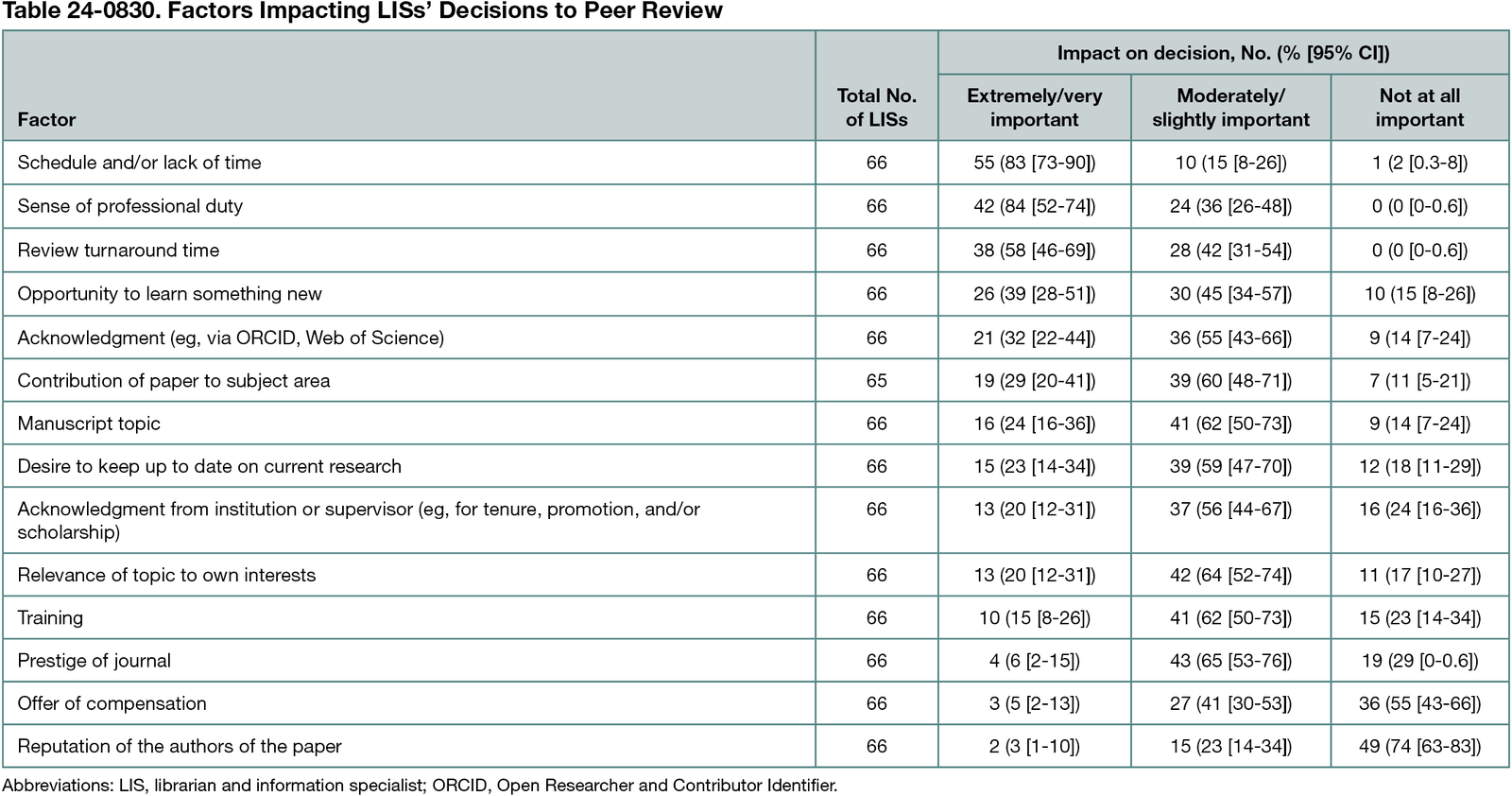
Of the 88 LISs invited to participate in the survey, 70 (79.5%) responded. Most respondents had 6 or more years of experience as an LIS (67/70; 95.7%) and advising researchers on doing SRs (55/70; 78.6%) and had peer reviewed for a journal prior to the study (57/70; 81.4%). Most focused on the search and SR methods when reviewing but also commented on aspects such as research question formulation, plagiarism, and study results and conclusions. Two-thirds (44/66; 66.7%) believed they impacted editors’ decision-making and 59.1% (39/66) believed they impacted the authors’ revisions. Only 3 factors were considered extremely or very likely to impact their decision to review again: their schedule and/or lack of time, review turnaround time, and their sense of professional duty (Table 24-0830). Seventeen of 27 invited LISs (63.0%) participated in a focus group. Time was the primary barrier identified in the focus groups, followed by a sense of intimidation. LISs reported being motivated by feeling valued by editors, the enjoyment of peer reviewing, the desire to improve SR quality, and peer review as a learning experience. Several expressed surprise and delight at being asked to peer review for the journals.
Conclusions
A select sample of highly engaged LIS respondents believed they made a difference through their peer reviews and said they were very likely to agree to peer review in the future. LISs may be an underused peer reviewing resource with methodological experience that can help editors make decisions and improve the quality of SRs.
Reference
1. Rethlefsen ML, Schroter S, Bouter LM, et al. Improving peer review of systematic reviews and related review types by involving librarians and information specialists as methodological peer reviewers: a randomised controlled trial. BMJ Evid Based Med. Published online March 11, 2025. doi:10.1136/bmjebm-2024-113527
1Health Sciences Library & Informatics Center, University of New Mexico, Albuquerque, NM, US, mlrethlefsen@gmail.com; 2ToxStrategies, A Blue Ridge Life Sciences Company, Baltimore, MD, US; 3BMJ Publishing Group, London, UK.
Conflict of Interest Disclosures
This study follows up on a study that was conducted as part of Melissa L. Rethlefsen’s self-funded PhD project registered at Maastricht University, the Netherlands, in collaboration with BMJ Publishing Group. Carrie Price was employed at the National Institutes of Health Library at the time of this research. Sara Schroter is a full-time employee of BMJ Publishing Group but is not involved in decision-making on individual research submissions.