
Factors Associated With Outcomes of Appeals of Manuscripts Initially Rejected by a General Medical Journal
Abstract
Matthew B. Stanbrook,1 Shannon Charlebois,1 George A. Tomlinson,1 Meredith Weinhold1
Objective
The opportunity to appeal a journal’s decision to reject a manuscript enhances procedural fairness toward authors and allows editors to correct errors in judgment but wastes time for both authors and editors when unsuccessful. We sought to identify factors associated with outcomes of appeals of research manuscripts at the Canadian Medical Association Journal (CMAJ), a general medical journal that explicitly highlights the option to appeal in rejection letters.
Design
We conducted a retrospective cohort study of all appeal requests for manuscripts initially rejected after submission to the Research section of CMAJ between 2007 and 2024. We obtained data on manuscript characteristics and editorial decisions from CMAJ’s manuscript submission database (ScholarOne). Three editors independently reviewed the text of the initial manuscript decision letters to identify reasons for rejection, with disagreements resolved by consensus. We included manuscripts rejected at any stage of the editorial process. The primary outcome was whether appeal requests were granted or denied. A secondary outcome was whether appealed manuscripts were ultimately published. We estimated associations of multiple prespecified characteristics with appeal outcomes using bayesian logistic regression.
Results
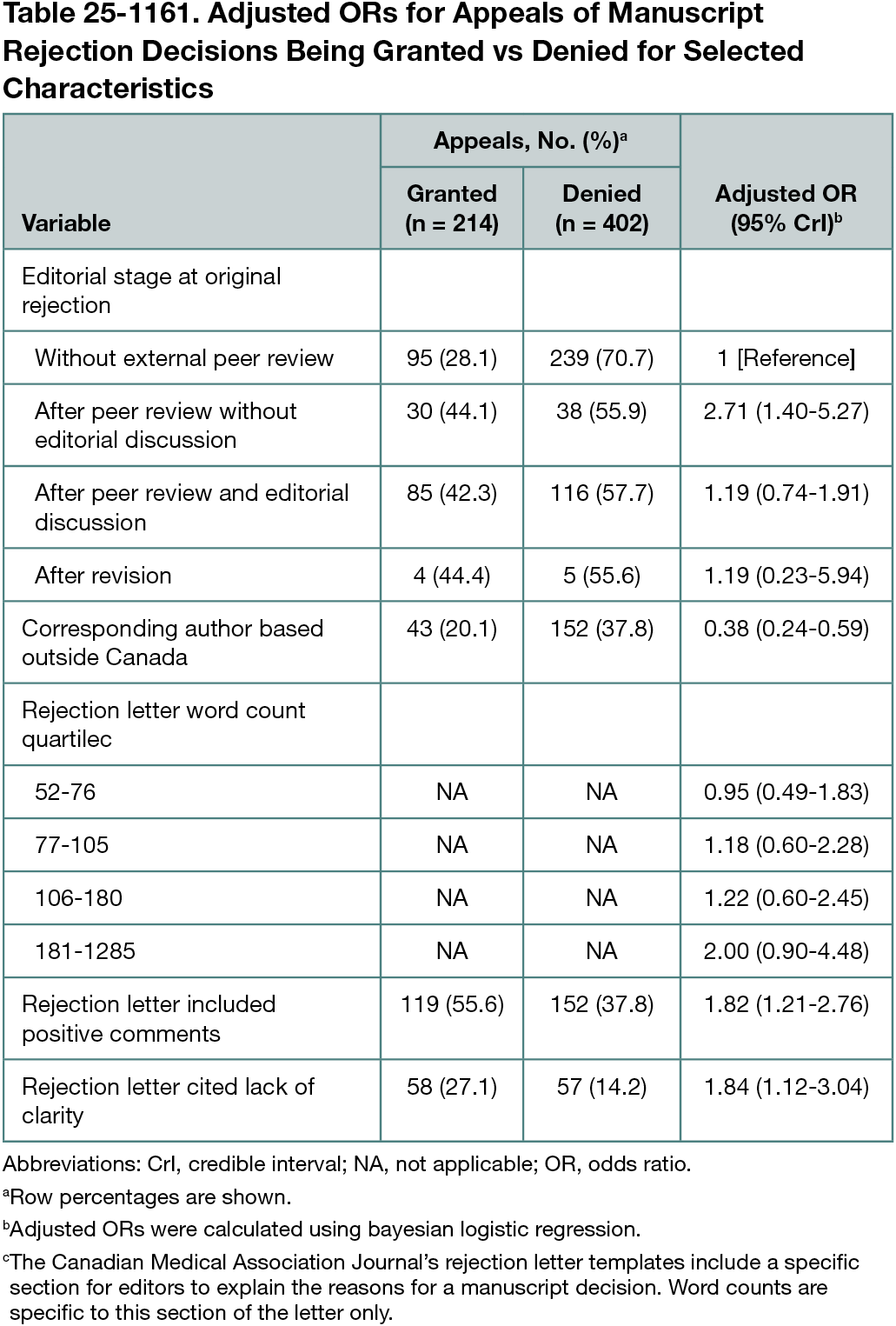
Among 14,351 submitted manuscripts, 13,419 were rejected, and 616 of these rejections (4.6%) were appealed. Among appeals, 214 (34.7%) were granted, of which 58 (27.1% of granted appeals and 9.4% of all appeals) were ultimately published. Compared with manuscripts rejected without external peer review, granted appeals were more likely for manuscripts rejected after peer review without editorial discussion (adjusted odds ratio [AOR], 2.71; 95% credible interval [CrI], 1.40-5.27) but similarly likely for manuscripts rejected after peer review and editorial discussion (AOR, 1.19; 95% CrI, 0.74-1.91) (Table 25-1161). Granted appeals were more likely if rejection letters included positive comments (AOR, 1.82; 95% CrI, 1.21-2.76) or cited lack of clarity (AOR, 1.84; 95% CrI, 1.12-3.04) and less likely if corresponding authors were based outside Canada (AOR, 0.38; 95% CrI, 0.24-0.59). The odds of an appeal being granted also varied significantly based on the individual editor making the appeal decision (median AOR, 1.90; 95% CrI, 1.24-4.37). Among factors associated with appeals being granted, only positive comments (AOR, 1.98; 95% CrI, 1.10-3.59) were also significantly associated with successful publication after appeal. However, appealed manuscripts rejected after peer review and editorial discussion were more likely to be published than were those rejected without peer review (AOR, 4.93; 95% CrI, 2.47-10.25).
Conclusions
Characteristics of authors, editors, editorial process, and decision communication were associated with successful appeals of initially rejected research manuscripts. Lack of awareness of the small fraction of appeals that ultimately achieve publication may raise false expectations among authors.
1Canadian Medical Association Journal (CMAJ), Toronto, Ontario, Canada, matthew.stanbrook@cmaj.ca.
Conflict of Interest Disclosures
All authors are employees or paid consultants of CMAJ. Matthew B. Stanbrook, Shannon Charlebois, and George A. Tomlinson participated in editorial decision making for some of the manuscripts included in the study. No other disclosures were reported.