
Factors Associated With Geographical Diversity of Reviewers Invited and Agreeing to Review for 21 Biomedical Journals
Abstract
Khaoula Ben Messaoud,1,2 Sara Schroter,3 Mark Richards,4 Angèle Gayet-Ageron1,2 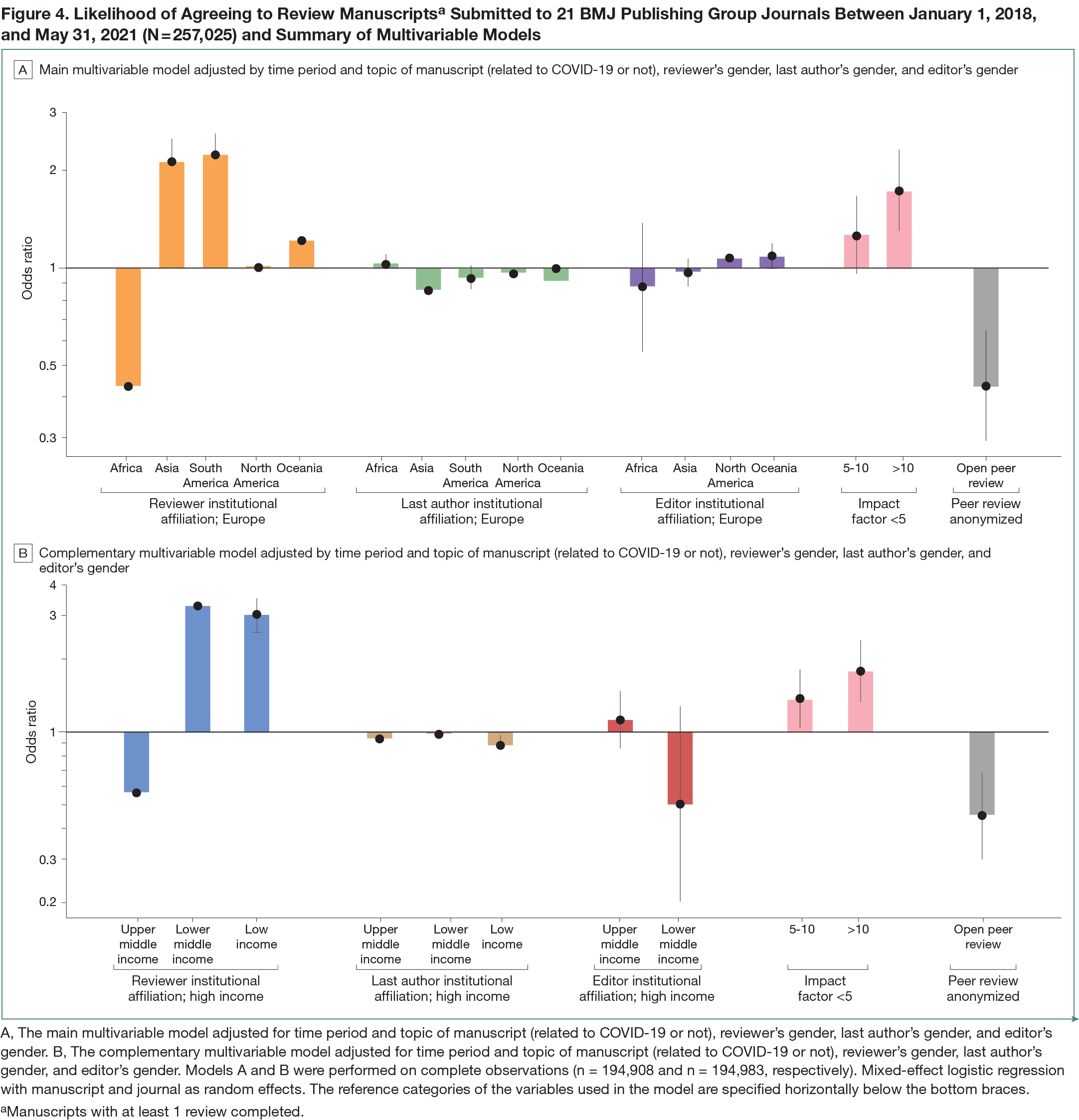
Objective
Geographical disparities have been observed in the acquisition of research grants and in the submission and publication of research articles. Peer reviewers are selected primarily based on their expertise through publication records. Response to peer invitation has been shown to be related to relevance of topic to own work, reviewer availability, journal attributes (impact factor and type of reviewer blinding) and compensation.1,2 However, diversity in terms of geographical distribution in response to peer invitations remains almost unexplored.3Design
Retrospective cohort study of all research manuscripts submitted to 21 BMJ Publishing Group biomedical journals between January 1, 2018, and May 31, 2021, and subsequently sent for review. Data were collected on geographical affiliation, income level of the country of affiliation (according to World Bank Data 2020), journal impact factor, and peer-review process (open vs anonymized). The primary outcome was response (agreed vs not agreed) to review invitation. A multivariable mixed-effects logistic regression model with random factors on the intercept at journal and manuscript levels was performed.Results
A total of 257,025 reviewers were invited to review and 90,467 (35.2%) agreed. The distribution of geographical affiliations of the invited reviewers were as follows: 10.0% in Africa, 8.8% in Asia, 47.6% in Europe, 26.0% in North America, 6.3% in Oceania, and 1.2% in South America. Among invited reviewers, 217,682 (84.7%) were affiliated with a high-income country. Figure 4 summarizes results from multivariable analysis. Agreement was higher among reviewers from Asia (2.13 [95% CI, 2.05-2.21]), Oceania (1.22 [95% CI, 1.17-1.27]), or South America (2.24 [95% CI, 2.06-2.45]) and lower among reviewers from Africa (0.43 [95% CI, 0.42-0.45] compared with Europe (P < .001). Agreement was significantly lower when the last author was from Asia (0.85 [95% CI, 0.83-0.87]) or Oceania (0.91 [95% CI, 0.87-0.95]) compared with Europe (P < .001). Reviewers agreed significantly more often when the associated editor had a North American institutional affiliation compared with a European affiliation (1.07 [95% CI, 1.02-1.12]). Compared with high-income countries, agreement was higher among reviewers from lower middle–income countries (3.26 [95% CI, 3.06-3.48]) and low-income countries (2.99 [95% CI, 2.57-3.48]) (P < .001). Agreement was also lower when the last author was from an upper middle–income country (0.94 [95% CI, 0.91-0.98]) or low-income country (0.88 [95% CI, 0.81-0.96]) compared with a high-income country (P < .001). Agreement was associated with impact factor (higher for impact factors between 5 and 10, or >10, compared with <5: 1.73 [95% CI, 1.29-2.32] and lower when peer-review process was open compared with anonymized: 0.43 [95% CI, 0.29-0.64]).