
Extracting Research Environment Indicators From the UK Research Excellence Framework 2021 Statements
Abstract
Noémie Aubert Bonn,1,2 Lukas Hughes-Noehrer1
Objective
The impact that research environments have on the quality of research has gained heightened visibility in the past few years. The Research Excellence Framework (REF), a UK-wide funding exercise that assesses higher education institutions (HEIs) on the excellence of their research, includes research environment as part of the elements it assesses. Recently, the weight of research environment was increased to one-fourth of the total score, bringing it closer to the other elements of research outputs and impacts. However, measuring positive research environments is challenging and clear indicators are still hard to delineate.
Design
To identify indicators that may be associated with positive research environments, we conducted a qualitative analysis of environment statements submitted to REF 2021.1 We sampled 34 four-star statements drawn from different units of assessment (ie, academic disciplines) available openly on the REF website. Four-star scores are given to statements that describe “an environment that is conducive to producing research of world-leading quality and enabling outstanding impact, in terms of its vitality and sustainability.” Using these statements, 1 researcher conducted a mix of inductive (first 17 statements in NVivo 12) and deductive (last 17 statements) thematic analysis to extract the potential indicators of positive research environments. These indicators were organized in core themes, discussed with the research team, and compared with existing recommendations, policies, and literature on healthy research environments to build an exhaustive overview of possible indicators.
Results
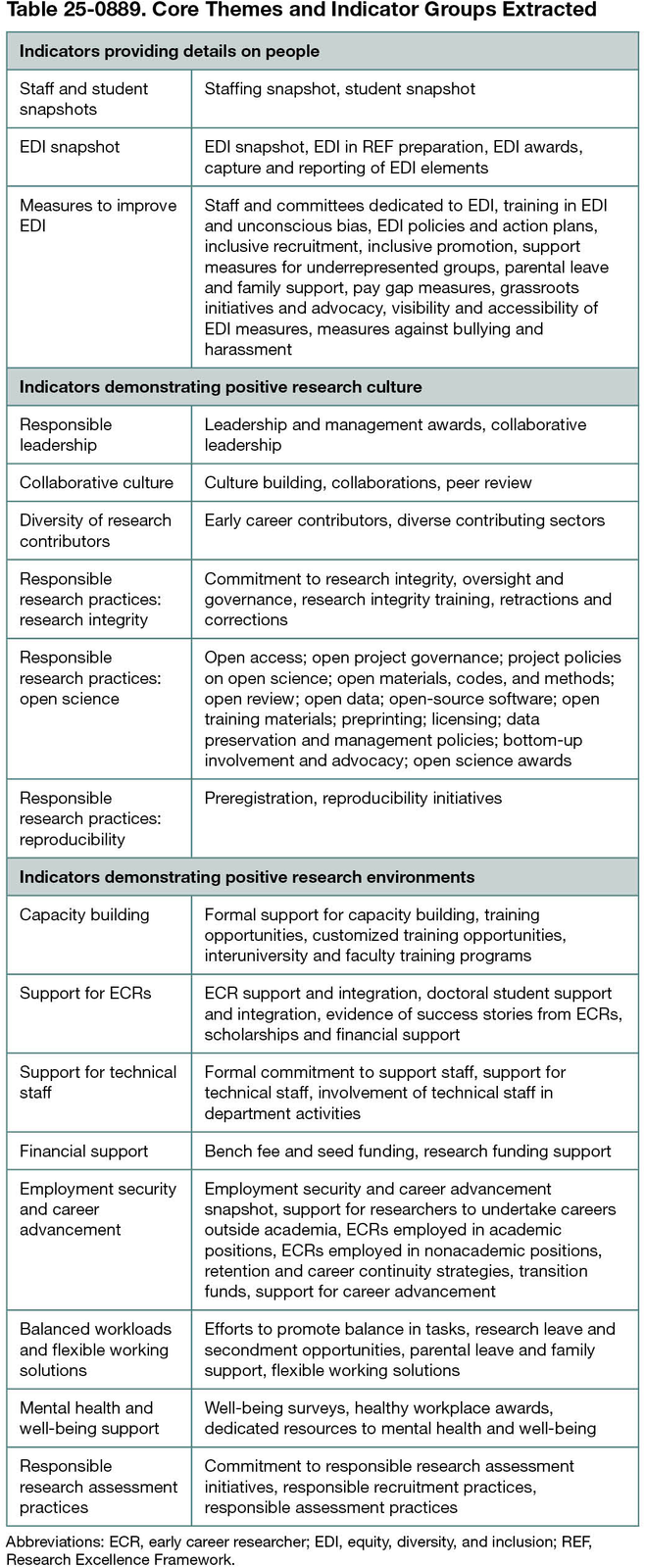
The analysis identified a vast array of elements, which were used to showcase positive research environments. We organized the elements extracted in indicators providing details on people, such as diversity metrics, staff and student characteristics, and measures to improve equity, diversity, and inclusion; indicators demonstrating positive research cultures, such as responsible leadership, collaborative culture, research integrity, and open research; and indicators demonstrating positive research environments, such as capacity-building measures, staff and financial support, employment security and progression, and responsible assessment practices (Table 25-0889). The breadth of indicators identified showcased differences and similarities in how different institutions and units of assessment qualified their research environments.
Conclusions
Our analysis provided insights on the breadth of elements that can come into play in creating a positive research environment. Despite being drawn from the UK landscape, our findings could be relevant to a broad diversity of research settings. For example, our findings could help support more comprehensive research assessment or they could help inspire concrete actions to improve research environments in HEIs.
Reference
1. Research Excellence Framework. Results and submissions. May 12, 2022. Accessed June 24, 2025. https://results2021.ref.ac.uk/
1The University of Manchester, Department of Computer Science, Faculty of Science and Engineering, Manchester, UK, noemie. aubertbonn@manchester.ac.uk; 2Hasselt University, Department of Healthcare & Ethics, Faculty of Medicine, Hasselt, Belgium.
Conflict of Interest Disclosures
Noémie Aubert Bonn was employed as a senior policy advisor with Research England from 2022 to 2023.
Funding/Support
The conceptualization, design, and part of the analysis was carried out and supported during Noémie Aubert Bonn’s employment at Research England. The analysis software subscription was provided by Hasselt University, Belgium.
Role of the Funder/Sponsor
The conclusions of the study are independent from Research England.
Acknowledgment
We wish to thank all the members of the People, Culture and Environment team at Research England who provided feedback and discussion throughout this project, particularly Catriona Firth, Claire Fraser, Steven Hill, Myles Furr, Marie-Helene Nienaltowski, Duncan Shermer, and Nicole Dixon. We also wish to thank everyone within UK Research and Innovation and The University of Manchester who provided feedback and insights on this project.