
Disclosed and Undisclosed Conflicts of Interest in US Guidelines for the Management of Obesity
Abstract
Alessandro Bianconi,1 Matteo Fiore,1 Maria Elena Flacco,2 Lamberto Manzoli1
Objective
Despite global initiatives to improve transparency regarding conflicts of interest (COIs) in scientific publications, the disclosure of competing interests remains inadequate among authors of clinical practice guidelines (CPGs), as well as for other types of publications.1,2 Open access databases like Open Payments offer a potential resource for assessing undisclosed COIs in scientific literature.3 This study evaluates the prevalence of undisclosed industry-related financial COIs among authors of US-issued CPGs on obesity management from 2016 to present.
Design
On June 3, 2024, we identified CPGs on obesity management issued by US agencies through 3 repositories (UpToDate, Medscape, and Guidelines International Network). COI statements for each guideline were extracted. To identify undisclosed industry-related financial COIs, we cross-referenced authors who reported no competing interests with the Open Payments database,3 considering only any form of payment and fund received prior to the guideline publication date. Undisclosed COIs were classified based on cumulative amounts as greater than or equal to $10,000 and less than $10,000. The presence of COIs was summarized as absolute and relative frequencies. Given the purely descriptive nature of this study, no hypotheses were tested.
Results
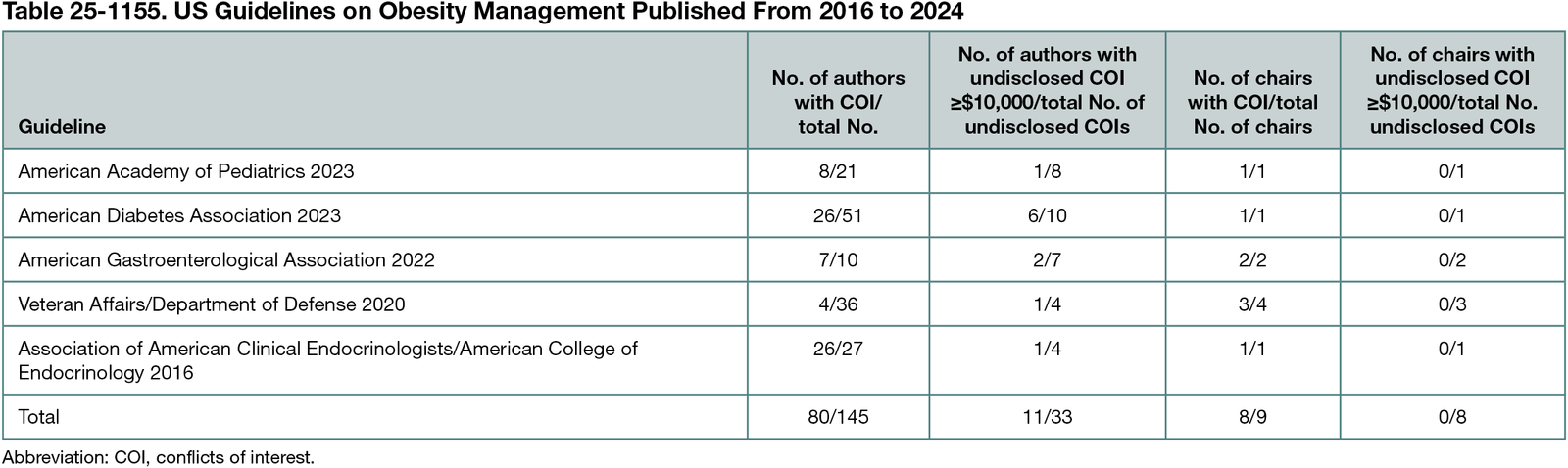
We retrieved 5 CPGs (American Academy of Pediatrics 2023, American Diabetes Association 2023, American Gastroenterological Association 2022, Veteran Affairs/Department of Defense 2020, Association of American Clinical Endocrinologists/American College of Endocrinology 2016) (Table 25-1155). Among 145 authors, 80 (55.2%) received payments from industry agents related to obesity prevention or treatment. Of these, 33 authors (41.3% [22.8% overall]) had undisclosed COIs. Among undisclosed COIs, 11 (33.3%) were greater than or equal to $10,000 and 22 (66.7%) were less than $10,000. Every guideline had at least 1 chair or first author with industry-related COIs. Seven of 9 (77.8%) of these prominent authors did not disclose any COI, though all undisclosed COIs were less than $10,000.
Conclusions
We found a relevant amount of undisclosed COIs in obesity management CPGs, and this amount may be underestimated because only financial interests could be evaluated. The presence of undisclosed COIs among CPG authors may reflect the complexities of COI disclosure rather than a straightforward lack of transparency. Variations in COI policies across scientific societies and publishers, which indicate the amount and type of payments that represent a COI that should be disclosed, may result in inconsistent reporting standards. This inconsistency presents an opportunity to harmonize COI management policies across publishing entities, promoting more comprehensive disclosure practices. Implementing regular monitoring of COI statements by peer reviewers and editors can further enhance transparency and trustworthiness. Tools like Open Payments can aid this process, though they have limitations, including potential inaccuracies and exclusion of nonfinancial COIs. Addressing these issues can strengthen the reliability of CPGs and other scientific publications. Further research should investigate the prevalence of undisclosed and overall COIs in other fields, assessing their potential impact on guideline recommendations and, thus, on real-world clinical practice.
References
1. Khan R, Scaffidi MA, Rumman A, Grindal AW, Plener IS, Grover SC. Prevalence of financial conflicts of interest among authors of clinical guidelines related to high-revenue medications. JAMA Intern Med. 2018;178(12):1712-1715. doi:10.1001/jamainternmed.2018.5106
2. Lenzer J, Hoffman JR, Furberg CD, Ioannidis JPA. Ensuring the integrity of clinical practice guidelines: a tool for protecting patients. BMJ. 2013;347:f5535. doi:10.1136/bmj.f5535
3. Open Payments. Accessed February 14, 2025. https://openpaymentsdata.cms.gov
1Department of Medical and Surgical Sciences, University of Bologna, Bologna, Italy, alessandro.bianconi4@studio.unibo.it; 2Department of Environmental and Prevention Sciences, University of Ferrara, Ferrara, Italy.
Conflict of Interest Disclosures
None reported.