
Developing a Harmonized Approach for Reporting Irradiation Protocols and Methods for Research Using X-ray Irradiators
Abstract
Warren Stern,1 Ioanna Iliopulos,2 Christopher Boyd2
Objective
The lack of agreement on minimum standards for disclosure of irradiation parameters results in the need to repeat costly studies, uncertainty in observed effects, and difficulty validating research outcomes. In turn, the Brookhaven National Laboratory (BNL) conducted a meta-study to gain greater quantitative and qualitative insights into this issue. After the results were published in 2022,1,2 2 annual Compatibility in Irradiation Research Protocols Expert Roundtable (CIRPER) meetings were conducted by BNL with the support of the National Nuclear Security Administration’s Office of Radiological Security. We describe the process of advocacy research that was implemented to address this issue—that is, conducting a technical meta-analysis, identifying gaps and actions based on its results, sufficiently addressing those gaps, and then publishing the outcome along with the recommendation in a peer-reviewed article to encourage dissemination and adoption by the wider community.
Design
The study that BNL published in 2022 identified over 450 published articles and demonstrated that although source specifications (eg, model, energy, and spectra) are well reported, experimental methodologies and irradiation protocols are not. Based on these findings, participants for CIRPER were carefully selected to represent a diverse segment of the radiation research community, such as from the fields of medical physics and radiobiology, working in academic, health care, and industry settings alongside federal partners, national laboratory personnel, and device manufacturer representatives. The meeting provided a venue to bring together diverse stakeholders that typically do not collectively interact and consisted of detailed workshops designed to parse out necessary methodological parameters for published and federally funded research.
Results
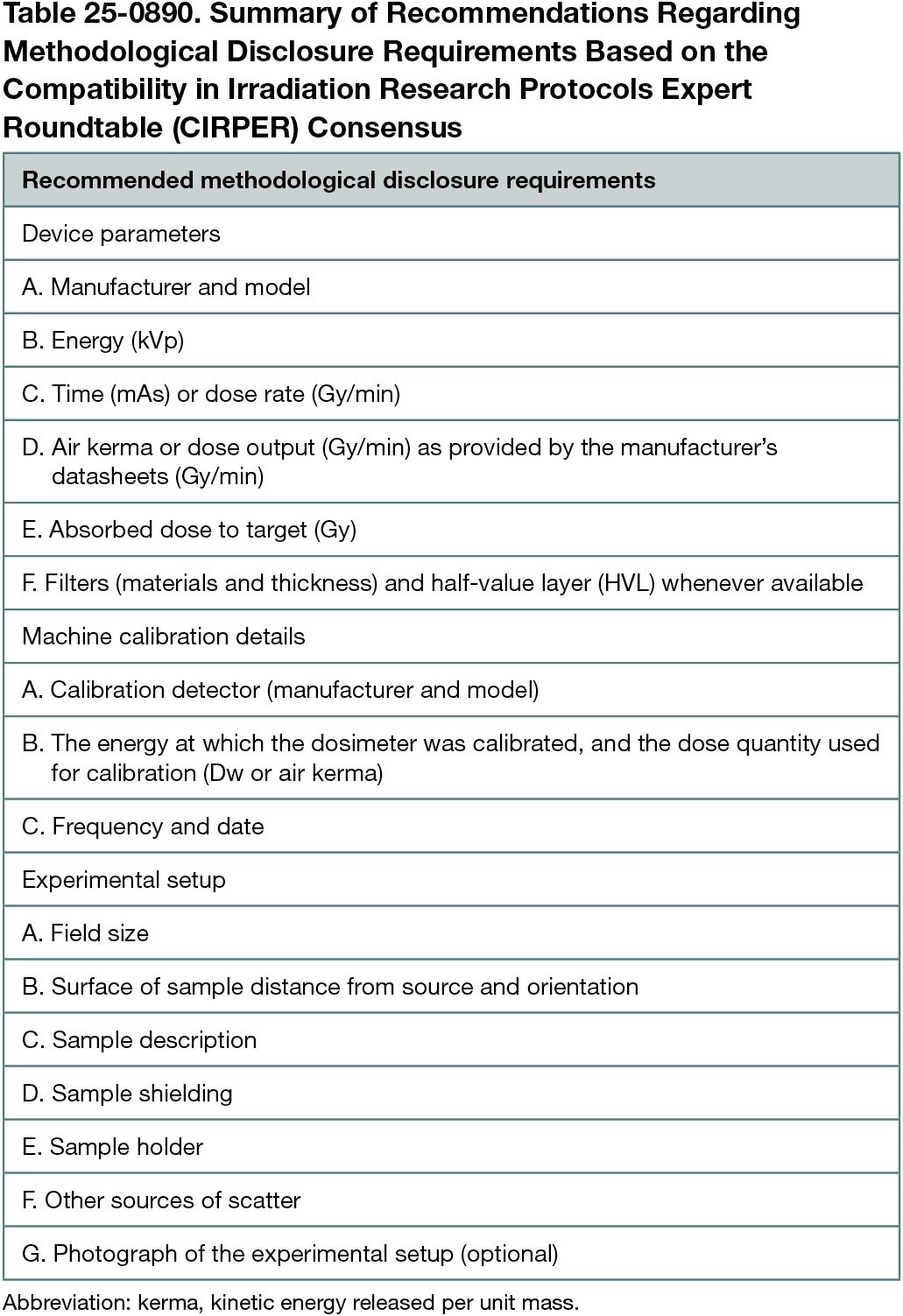
To increase transparency and reproducibility, experts at the meeting agreed on a standard set of disclosure requirements researchers working with x-ray irradiators should include when publishing their work (Table 25-0890). The meeting also resulted in further discussions on how session participants can support CIRPER’s efforts to harmonize the reporting of irradiation protocols and methods.
Conclusions
As the research community moves to x-ray–based irradiation technologies from cesium 137–based ones, reporting parameters must adapt and update accordingly. The BNL meta-analyses uncovered data that quantifies this barrier. A strategy for advocacy research was designed and implemented accordingly to appropriately address this problem by (1) further identifying gaps in the reporting process, (2) gathering relevant stakeholders to design an informed approach, and (3) gaining commitment from journal editorial boards, funding agencies, and researchers to adopt CIRPER recommendations. This effort has already had a positive impact on the quality of peer-reviewed and funded research and serves as a model for improving other aspects of peer review and publication.3
References
1. Stern W, Zia S, Boyd C, Iliopulos I, Peiris P, Fedurin M. Alternative Technologies Meta Study Report. US Department of Energy; 2022. doi:10.2172/1895064
2. Stern W, Zia S, Boyd C, Iliopulos I. Alternative Technologies Adopters Outreach Survey Report. US Department of Energy; 2022. doi:10.2172/1895065
3. Stern W, Alaei P, Berbeco R, et al. Achieving consistent reporting of radiation dosimetry by adoption of compatibility in irradiation research protocols expert roundtable (CIRPER) recommendations. Radiat Res. 2024;201(3):267-269. doi:10.1667/RADE-23-00234.1
1Brookhaven National Laboratory, Upton, NY, US, wstern@bnl.gov; 2MARC Strategics, Ann Arbor, MI, US.
Conflict of Interest Disclosures
None reported.
Funding/Support
This work was funded and sponsored by an agency of the US government.
Role of the Funder/Sponsor
The funder had no role in the design and conduct of the study; collection, management, analysis, and interpretation of the data; preparation, review, or approval of the manuscript; and decision to submit the manuscript for publication.
Disclaimer
Neither the US government nor any agency thereof, nor any of their employees, nor any of their contractors, subcontractors, or their employees, makes any warranty, express or implied, or assumes any legal liability or responsibility for the accuracy, completeness, or any third party’s use or the results of such use of any information, apparatus, product, or process disclosed, or represents that its use would not infringe privately owned rights. The views and opinions of the authors expressed herein do not necessarily state or reflect those of the US government or any agency thereof.