
Citation Biases and Citation-Boosting Strategies: A Scoping Review of Predictors
Abstract
Hans Lund,1 Karen Lie,2 Karen Robinson,3 Jong-Wook Ban,4 Birgitte Nørgaard5
Objective
Researchers’ citation practices are influenced by a wide range of factors, many of which are unrelated to scientific quality or relevance, raising concerns about citation bias. Given the conceptual ambiguity, methodological heterogeneity, and ethical implications surrounding this topic, a scoping review was conducted to map the literature, classify study intentions, and identify research gaps. The objective was to systematically map the predictors of citation rates and categorize the types of studies evaluating these factors.
Design
This was a scoping review to identify all studies assessing predictors of citation rates within the health sciences, with a particular focus on citation bias—defined as the selective citation of literature based on specific characteristics rather than scientific merit.
Results
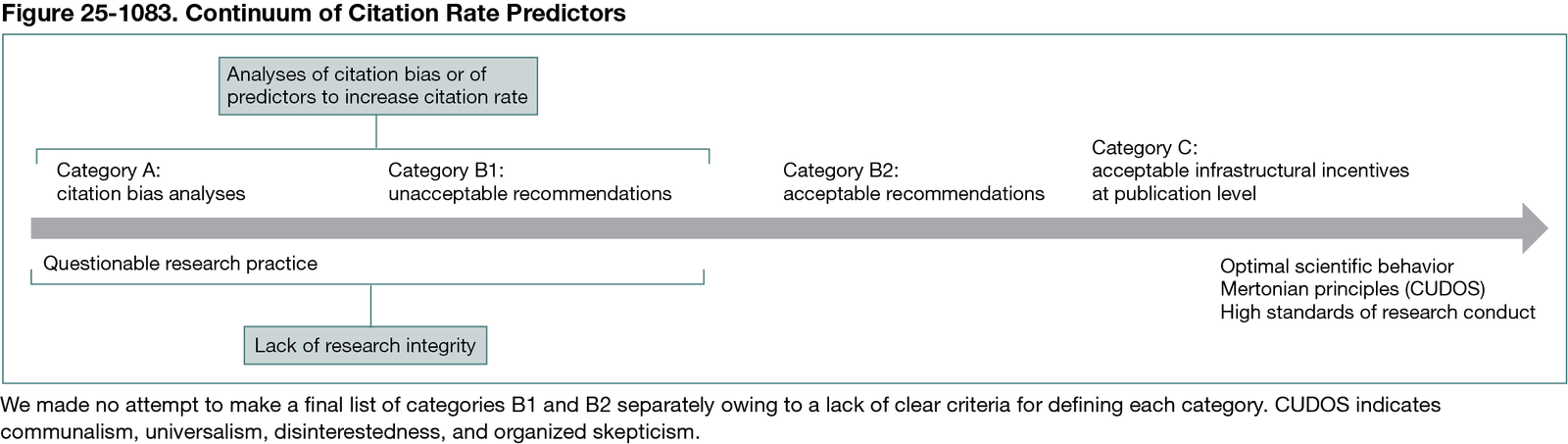
A total of 165 studies published between 1982 and 2023 were included. Fifty-four distinct factors were identified, encompassing 4,471,352 original studies, and were grouped into 4 categories: author-related (n = 17), study-related (n = 19), reporting-related (n = 10), and journal-related (n = 8). Among the 786 analyses evaluating these factors, 429 (54.6%) identified a significant increase in citation rates, 49 (6.2%) found a decrease, and 251 (31.9%) reported no effect. Most factors associated with increased citation rates were unrelated to the scientific content of the studies and instead reflected extrinsic characteristics. As the intention, interpretation of results, and conclusions varied considerably across the included studies, we categorized them based on how they analyzed factors associated with citation rates (Figure 25-1083). Of the 165 studies, 77 (46.7%) were classified under category A, which examined citation bias. In contrast, 81 studies (49.1%) (categories B1 and B2) recommended leveraging specific characteristics to enhance authors’ own citation rates. Category B was further subdivided due to ambiguity in distinguishing ethically acceptable recommendations from potentially conflicting (ie, unacceptable) ones. Seven studies (4.2%) examined factors that could improve the accessibility of published studies. Figure 25-1083 presents these categories along a continuum ranging from questionable research practices to optimal scientific behavior.
Conclusions
Many factors associated with increased citation rates were unrelated to the scientific content of the studies. Furthermore, authors of nearly half of the studies explicitly recommended modifying paper characteristics to boost citations rather than prioritizing scientific contribution. Such recommendations may conflict with principles of scientific integrity, which emphasize relevance and methodological rigor over strategic citation practices. Furthermore, the results provide a robust foundation for conducting meta-analyses to quantify the extent of the problem, as they offer a comprehensive and systematically derived list of factors influencing citation rates. The high proportion of significant results suggests possible publication bias.
1Section of Evidence-Based Practice, Western Norway University of Applied Sciences, Bergen, Norway, hans.lund@hvl.no; 2VID Specialized University, Bergen, Norway; 3Johns Hopkins Evidence-Based Practice Center, Johns Hopkins University, Baltimore, MD, US; 4Section of Hospital Medicine, University of Chicago, Chicago, IL, US; 5Department of Public Health, University of Southern Denmark, Odense, Denmark.
Conflict of Interest Disclosures
None reported.