
Automated Targeted E-mails for Improving Author Compliance With Study Reporting Requirements and Other Editorial Processes
Abstract
Daniel S. Evanko,1 Deondre Jordan1
Objective
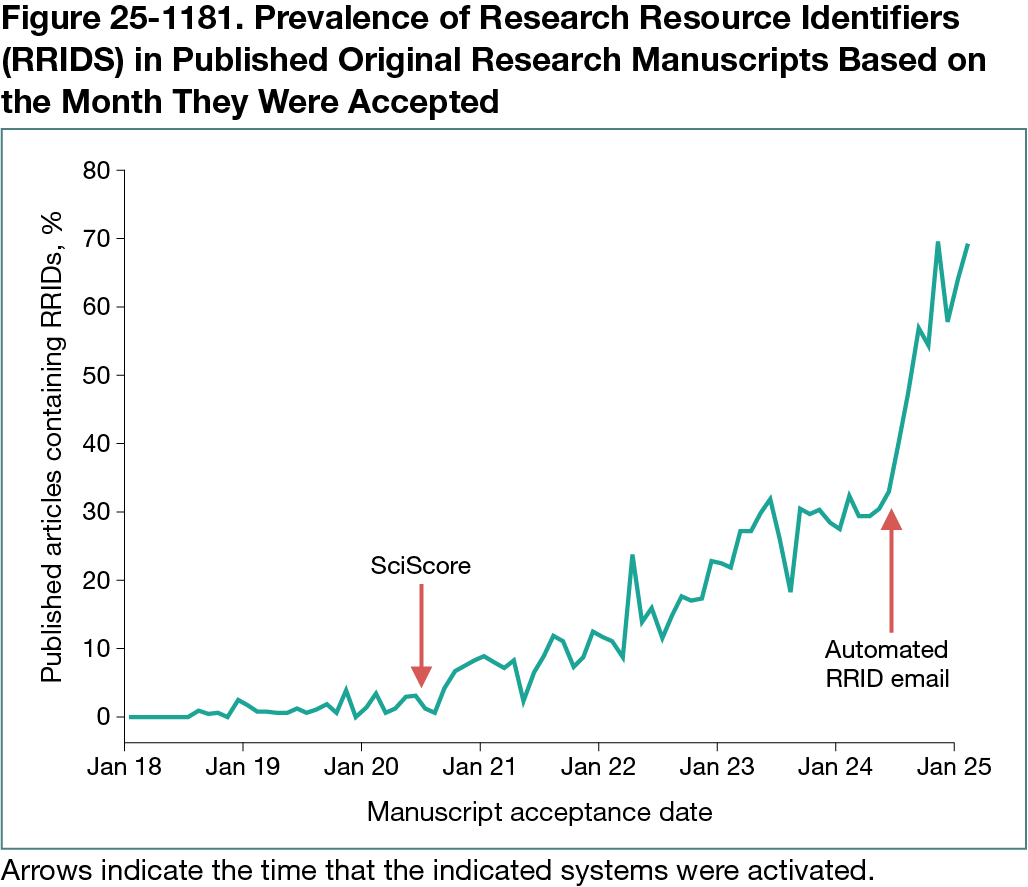
Journals ask authors to comply with many reporting requirements to improve study transparency, reproducibility, and reuse. Manual monitoring and enforcement of requirements is difficult, and reporting checklists or vendor-based solutions can be untargeted, burdensome, expensive, or of limited effectiveness. For example, since June 2020 the American Association for Cancer Research has used a methods review tool (SciScore) to help improve author compliance with reporting requirements at its 10 journals. This tool greatly increased author assignment of research resource identifiers (RRIDs),1 but compliance plateaued at approximately 30% of original research articles published in the association journals. This cross-sectional study describes a simple, inexpensive, automated approach to further overcome limitations of common approaches and quantitatively evaluates its performance using 3 example interventions.
Design
Custom Python scripts coupled with structured language queries were used for targeted extraction of manuscript data from the EJournal Press journal submission system. For RRID reporting compliance, once every day the submission system was queried for manuscripts that completed initial quality control checks and did not contain the text RRID. A templated e-mail alert was sent to the corresponding author that explained what RRIDs are, why they are important, and how to add them. The system was also adapted with a custom supervised machine-learning method to identify studies that generated new sequencing data or that were computationally intensive to encourage authors to deposit sequence data and provide computer code used in their study and used to send different alerts for these manuscripts at different designated points in the editorial process.
Results
The new automated RRID process was activated August 6, 2024, at all the association journals, resulting in missing-RRID alerts sent for 84% (4949 of 5899) of manuscripts at completion of initial quality control checks through the end of 2024. Performance was assessed by searching for “RRID” in published articles as done previously.1 An immediate sharp increase in articles containing RRIDs was observed that quickly increased the percentage of published research articles containing RRIDs from 33% (176 of 526) in April through July to 65% (330 of 505) in November through February (Figure 25-1181). Targeted alerts to authors of manuscripts asking them to deposit sequencing data (sent after peer review started) or supply code in a computational science software (Code Ocean) capsule (sent after a revise decision was sent to the author) were turned on on August 26, 2024, and resulted in sequence deposition alerts sent for 43% (1416 of 3261) of manuscripts and Code Ocean alerts sent for 39% (614 of 1594) of manuscripts through April 30, 2025. The sequencing alert triggered more than 100 author e-mail communications about deposition, demonstrating author engagement with this request and allowing resolution early in the editorial process. The percentage of accepted manuscripts with linked Code Ocean capsules increased from 1.4% (21 of 1555) in 2024 to 4.6% (25 of 547) in the January to May 2025 period, a more than 3-fold increase.
Conclusions
This fully automatic and highly targeted process engages with authors in a context-dependent way at predefined times in the editorial process that are appropriate for the specific communication, thus achieving substantial author engagement and improved compliance with journal requirements.
Reference
1. Roelandse M, Ozykurt IB, Evanko D, Bandrowski A. Assessing the effectiveness of SciScore in supporting the reproducibility of scientific research. Sci Ed. 2023;46:46-52.
1American Association for Cancer Research, Philadelphia, PA, US, daniel.evanko@aacr.org.
Conflict of Interest Disclosures
Daniel S. Evanko is a member of the Peer Review Congress Advisory Board but was not involved in the review or decision for this abstract.