
Authors Who Publish in a Journal and Likelihood to Serve as Reviewers
Abstract
Stephan D. Fihn,1,3 Roy H. Perlis,2,3 Jacob Kendall-Taylor,3 Annette Flanagin3
Objective
The major challenges for editors of journals include attracting submissions of high-quality manuscripts and recruiting reviewers.1 In light of a dearth of relevant research, we sought to ascertain the association between publishing manuscripts as an author and participation in peer review for the same journal.
Design
We conducted a cross-sectional study using data extracted about authors and reviewers for JAMA Network Open, a high-volume open access general medical journal, for the years 2019 to 2023, including number of articles submitted and published as first or corresponding author during this period, numbers of requests to review and response (submitted, declined, no response), and quality of review submitted as determined by reviewing editor on a 5-point Likert scale (excellent = 1 to poor = 5). Data were analyzed using R 4.4.2.
Results
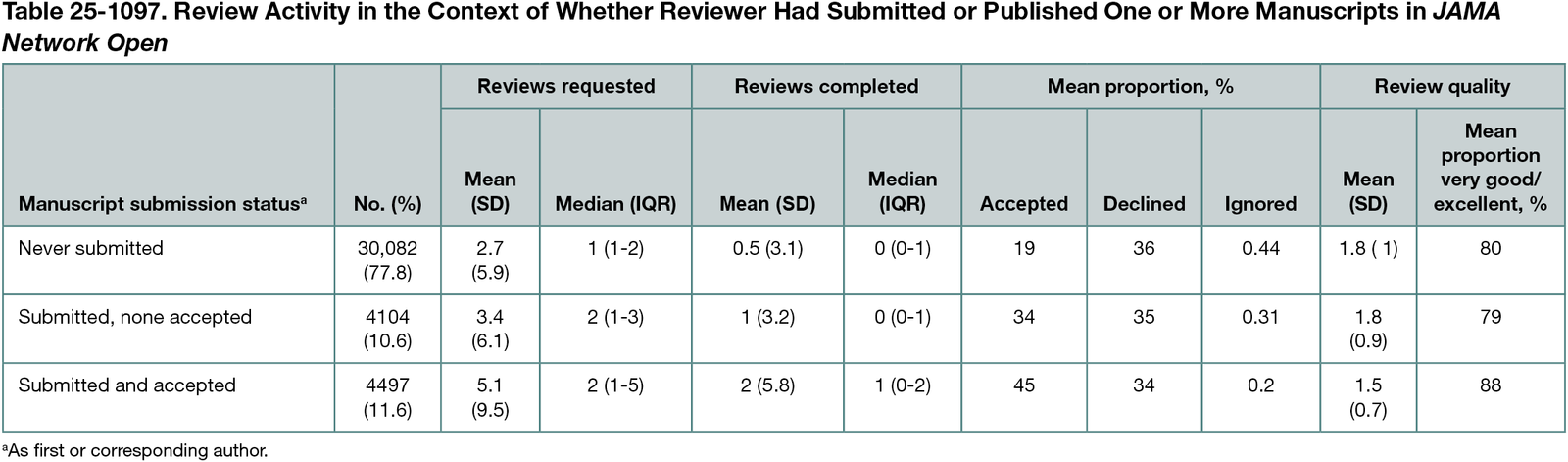
Among 38,683 invited reviewers, 30,082 (77.8%) submitted no manuscripts; 4014 (10.6%) submitted ≥1 article as first or corresponding author but had no published articles; and 4497 (11.6%) submitted ≥1 article as first or corresponding author and had ≥1 publication. Table 25-1097 summarizes review requests to these individuals and compares their rates of accepting reviews and ratings among those who returned reviews. The mean (SD) number of invitations was greatest among published reviewers (5.1 [9.5]), followed by those with submissions but no publications (3.4 [6.1]), and then individuals with no submissions (2.7 [5.9]) (P < .007 by analysis of variance). Reviewers with publications were significantly more likely to accept invitations and significantly less likely to ignore invitations compared with the other 2 groups (P < .01 by analysis of variance and post hoc pairwise test). The absolute difference in proportion of accepted invitations was 26.2% (95% CI, 24.8%-27.6%; P < .001) between published and never-submitted reviewers and 11.6% (95% CI, 9.7%-13.5%; P < .001) between published and nonpublished submitters. Among those who returned reviews, quality (mean rating) was significantly higher among reviewers with publications (absolute difference from nonsubmitters: 0.25; 95% CI, −0.29 to −0.20; P < .001). Differences between submitters without publications (mean difference: 0.03) and never-submitters (mean difference: 2.5%) were minimal for both rating metrics (P > .50).
Conclusions
Authors who published in JAMA Network Open were significantly more likely to accept an invitation to review even though they received nearly twice as many requests as those who did not publish. Moreover, the quality of their reviews was significantly greater. Individuals who submitted manuscripts but did not publish were intermediate between these 2 groups in terms of accepting invitations to reviews and quality of reviews. These results suggest that investigators may be willing to commit more of their academic effort to journals that publish their work. Limitations of this analysis include the inability to determine the relative timing of publication versus review; restriction of the analysis to a single high-volume journal; exclusion of co-authors; and limitation to a 4-year time frame.
Reference
1. Zupanc GKH. “It is becoming increasingly difficult to find reviewers”—myths and facts about peer review. J Comp Physiol A Neuroethol Sens Neural Behav Physiol. 2024;210(1):1-5. doi:10.1007/s00359-023-01642-w
1Department of Medicine, University Washington, Seattle, WA, US; steve.fihn@jamanetwork.org; 2Department of Psychiatry, Massachusetts General Hospital and Harvard Medical School, Boston, MA, US; 3JAMA Network, Chicago, IL, US.
Conflict of Interest Disclosures
Stephan D. Fihn (SDF) and Roy H. Perlis (RHP) are paid as consultants for work as editors of JAMA Network Open (SDF and RHP) and JAMA+ AI (RHP). Jacob Kendall-Taylor and Annette Flanagin are on the editorial staff of the JAMA Network. Annette Flanagin is a member of the Peer Review Congress Advisory Board but was not involved in the review or decision for this abstract. None of the authors have any other conflicts of interest to disclose.
Funding/Support
The authors received no direct funding for this work apart from that described above.