
Assessment of Gender Balance in the Editorial Activities of a Researcher-Led Journal
Abstract
Tal Seidel Malkinson,1 Devin B. Terhune,2 Mathew Kollamkulam,3 Maria J. Guerreiro,4 Dani S. Bassett,5,6,7,8,9,10 Tamar R. Makin3 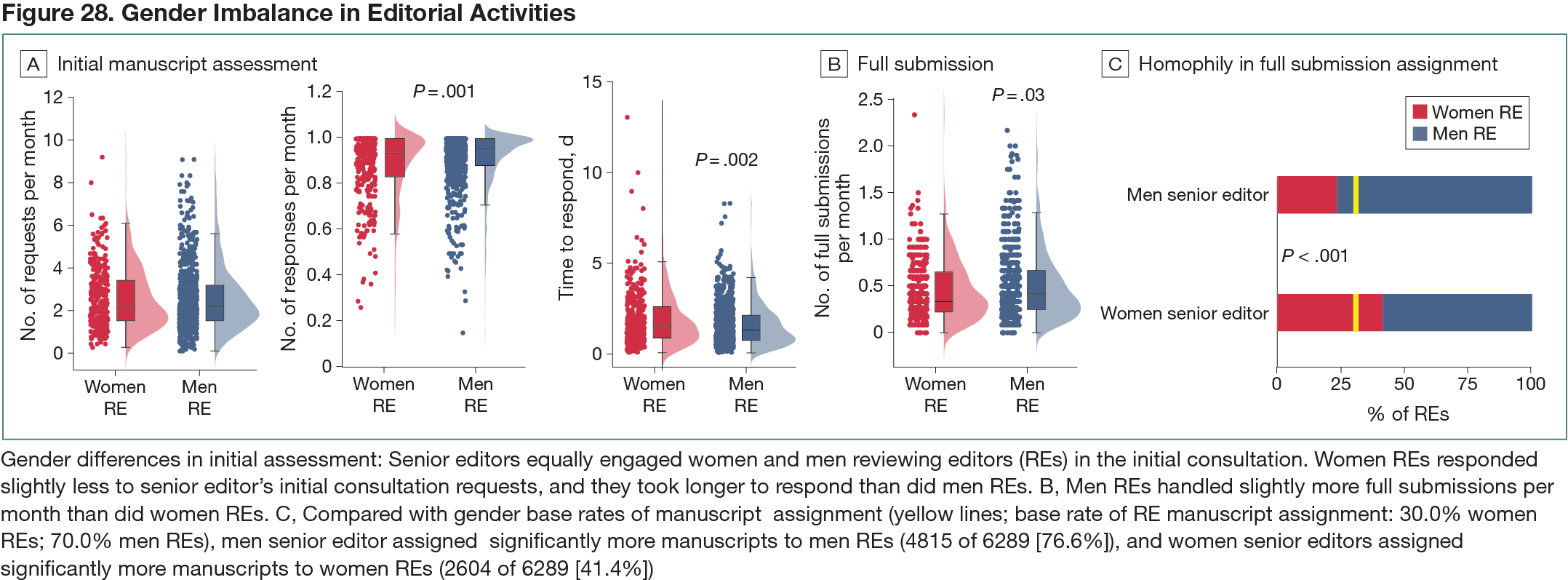
Objective
Editorial decision-making is a fundamental element of the scientific enterprise, with critical implications for career advancement. Despite repeated calls for making deliberate efforts to incorporate gender diversity into editorial board structures, gender disproportions remain pervasive.1,2 Gender parity in the contributions to editorial decisions at various stages of the publication process was examined, based on analytics collected by the biomedical researcher–led journal eLife.Design
Data accumulated by eLife’s platform from 2017 to 2019 were organized into 2 data sets. The reviewing editor (RE) data set included anonymous information on the engagement of individual REs (n = 1201) in the editorial process, with a binary gender assigned based on the editor’s name and gender expression. REs were consulted by senior editors at the initial assessment stage, and an RE was chosen to handle the full review process for the selected manuscripts. The manuscript data set included the outcome of submitted manuscripts (n = 24,056) in each submission stage, the assigned gender of the REs suggested by the authors, the assigned gender of the handling RE, and the assigned gender of the appointed senior editor. Owing to nonnormal distributions in the data, 2-tailed nonparametric tests were used, including (1) binomial tests and N − 1 χ² proportion comparison tests, (2) contingency table analysis, (3) a permutation-based Welch independent t test, and (4) equivalent bayesian analyses when significance was close to P < .05.Results
Despite efforts to increase women representation, the board of REs was predominantly male (833 [69.4%]). Authors suggested fewer women as REs, even after correcting for men overrepresentation (29.08% women vs 30.6% men; χ²1 = 11.65; P = .001; Cohen h = 0.90). Although women editors were proportionally involved in the initial manuscript assessment (mean [SD] number of assessment requests per month, 2.40 [1.44] women REs vs 2.41 [1.51] men REs; t809.7 = 0.11; P = .92), they were underengaged in the full review process (mean [SD] number of full submissions per month, 0.40 [0.32] women REs vs 0.44 [0.37] men REs; t869.8 = 2.22; P = .03; Hedges g = 0.13). Gender homophily in manuscript assignment was found, such that senior editors overengaged same-gender REs (χ²1 = 224.55; P < .001; contingency coefficient of 0.186) (Figure 28). This tendency was stronger in more gender-balanced scientific disciplines (eg, in developmental biology, with 56.9% of manuscripts handled by men REs; r = −0.47; P = .05; Bayes factor10 = 1.77).