
Artificial Intelligence Editorial Policies and Reporting Standards in Orthopedic and Sports Medicine Journals
Abstract
Josh Major,1 Kurt Mahnken,1 Alec Young,1 Cameron O’Brien,1 Andrew V. Tran,1 Patrick Crotty,1 Alicia Ito Ford,1,2 Matt Vassar1,2
Objective
The integration of artificial intelligence (AI) in scientific research presents both opportunities and challenges, particularly concerning transparency, ethics, and reproducibility.1 This study aimed to evaluate how leading orthopedic and sports medicine (OSM) journals address 2 distinct outcomes: (1) the extent to which AI is permitted in research and publication and (2) the degree to which OSM journals are endorsing AI-specific reporting guidelines (RGs). The primary outcome was to assess the presence of AI-related policies, including requirements for AI disclosure, acceptance or prohibition of AI-generated images and content, and AI’s role in manuscript writing and authorship. Secondary outcomes examined the endorsement of AI-specific RGs and the relationship between AI policies and Journal Impact Factor.
Design
We conducted a cross-sectional analysis of the top 100 OSM journals ranked by the 2023 SCImago Journal Rank (SJR) indicator. Eligibility criteria included actively publishing peer-reviewed clinical journals with publicly accessible Instructions for Authors in English language. On September 29, 2024, 2 investigators independently screened, extracted, and reconciled data in a masked, duplicate manner. Data were extracted from journals’ Instructions for Authors pages and affiliated publisher websites where indicated. If a journal had no mention of AI policies or AI-specific RGs, the editorial teams were contacted directly to inquire about these gaps. Biserial correlation analyses in R version 4.4.1 (The R Foundation) and RStudio (Posit) examined AI policy relationships with Journal Impact Factor and SJR.
Results
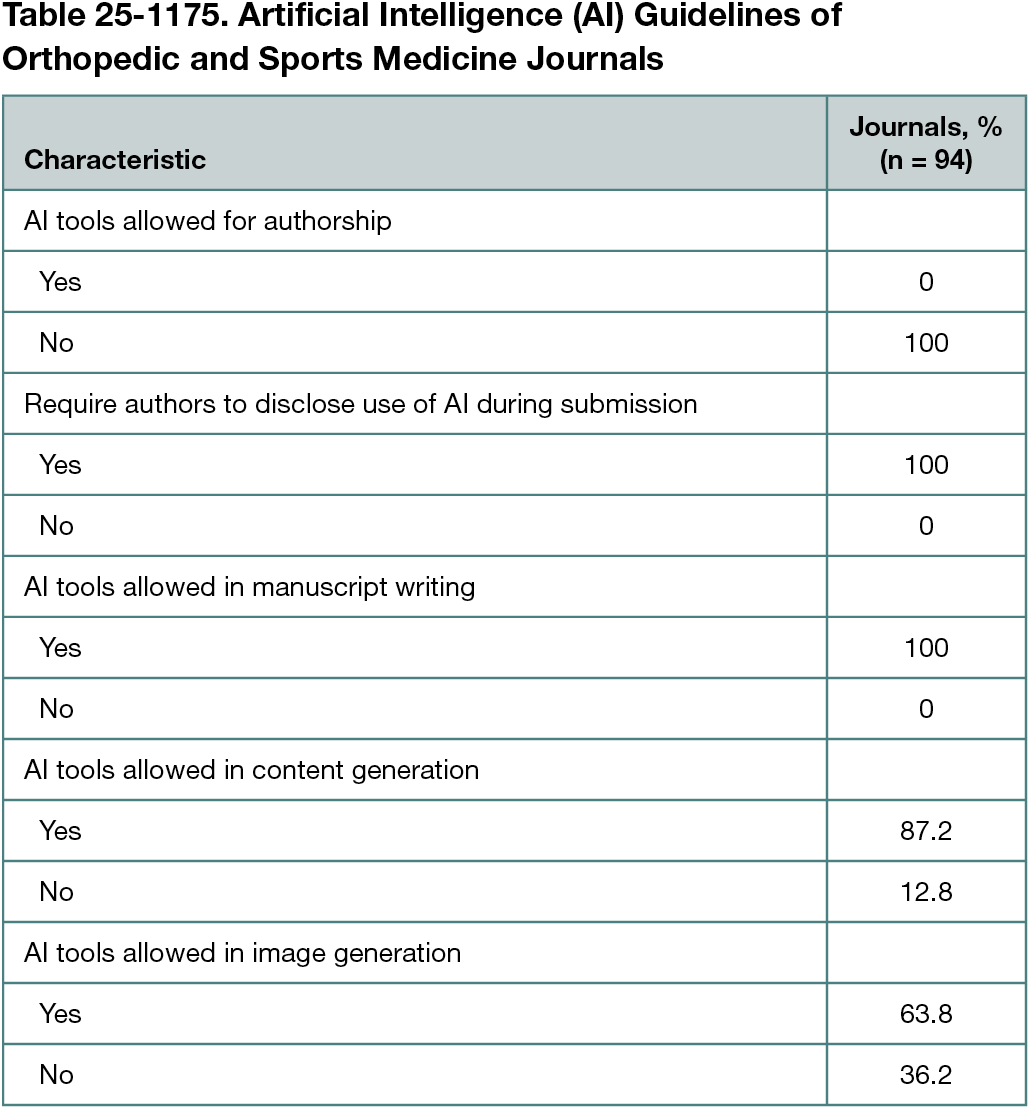
The initial search yielded 319 journals, from which the top 100 were analyzed. Of these, 94 mentioned AI in their Instructions for Authors, with all 94 requiring disclosure of AI use and prohibiting AI as an author (Table 25-1175). Additionally, AI-assisted manuscript writing was permitted in all cases, while 87% allowed AI-assisted content generation and 64% permitted AI-generated images. Despite this widespread recognition of AI policies, AI-specific RGs were endorsed in only 1% of journals, recommending the use of the Checklist for Artificial Intelligence in Medical Imaging (CLAIM) RG. No significant associations were observed between Journal Impact Factor and the presence of AI-related editorial policies. Additionally, no differences were found among the AI policies in the 4 quartiles of the OSM journals in this study.
Conclusions
While some AI use in research is widely acknowledged by OSM journals, the lack of consistency in policies regarding AI-generated images and content suggest an area for improvement to standardize how AI can be applied in these journals. Furthermore, the lack of endorsement for AI-specific RGs suggests a critical gap in ensuring the transparency and methodological rigor of AI-integrated research. To address these issues, we recommend that OSM journals establish clear AI policies and endorse AI-specific RGs. The International Committee of Medical Journal Editors, Committee on Publication Ethics, and World Association of Medical Editors have taken initial steps; however, implementation may be difficult.2 Implementing these measures will bridge existing gaps, promote transparency, and improve research quality in scientific publishing.
References
1. Prasana P, Mandal PK, Hussain D, et al. Intersection of orthopaedics and artificial intelligence: a review. SSR Inst Int J Life Sci. 2024;10(3):5544-5552. doi:10.21276/ssr-iijls.2024.10.3.21
2. Simera I, Moher D, Hoey J, Schulz KF, Altman DG. The EQUATOR Network and reporting guidelines: helping to achieve high standards in reporting health research studies. Maturitas. 2009;63(1):4-6. doi:10.1016/j.maturitas.2009.03.011
1Office of Medical Student Research, Oklahoma State University Center for Health Sciences, Tulsa, OK, US, youngalec9.r@gmail.com; 2Department of Psychiatry and Behavioral Sciences, Oklahoma State University Center for Health Sciences, Tulsa, OK, US.
Conflict of Interest Disclosures
Alicia Ito Ford reports receipt of funding from the Center for Integrative Research on Childhood Adversity, the Oklahoma Shared Clinical and Translational Resources, and internal grants from Oklahoma State University and Oklahoma State University Center for Health Sciences outside of the present work. Matt Vassar reports receipt of funding from the National Institute on Drug Abuse, the National Institute on Alcohol Abuse and Alcoholism, the US Office of Research Integrity, Oklahoma Center for Advancement of Science and Technology, and internal grants from Oklahoma State University Center for Health Sciences outside of the present work. No other disclosures were reported.
Additional Information
Andrew V. Tran is a co–corresponding author (andrewtranresearch@gmail.com).