
Analysis of Editorials on the Response to the H1N1 and COVID-19 Pandemics
Abstract
Luka Ursić,1,2 Nensi Bralić,1 Giovanni Spitale,2 Federico Germani,2 Ana Marušić1
Objective
Divisive discourse observed in news coverage or social media posts by researchers and the general public during the H1N1 and COVID-19 pandemics contributed to polarization and politicization, rapid shifts in sentiment, and concerning rates of misinformation.1-3 We aimed to study the sentiment and natural language processing (NLP) analysis of editorial material in medical journals discussing the health care system response to the 2 pandemics.
Design
Using a systematic review design, we searched Web of Science and PubMed up to May 22, 2024, for editorials, viewpoints, and similar opinion pieces discussing the following segments of the health care system response to the 2 pandemics: nonpharmaceutical interventions; misinformation or disinformation; health care resource allocation and management; health care system preparedness; mandates, policies, and guidance related to research, education, or new technologies; and lessons learned. We limited our search to 2009 to 2014 for the H1N1 pandemic and 2019 to 2024 for the COVID-19 pandemic. Three researchers screened the titles, abstracts, and full texts of the retrieved records for eligibility in pairs, resolving discrepancies through discussion. We extracted the text from the included records’ PDFs using Python and performed a sentiment analysis using the Language Inquiry and Word Count 2022 software. We also used NLP approaches (flat lemmatization, convoluted lemmatization, rule-based autocoding, and cosine similarity) to determine the most frequently used lemmas in the 2 groups of editorials and explore topics based on their co-occurrence. We conducted inferential analyses at the level of the full sample and across specific categories (ie, stratified by pandemic, author country, and context of response). While we could not set a hypothesis for the exploratory NLP analysis, we hypothesized that in terms of sentiment, the editorials published during the COVID-19 pandemic would have higher scores for negative tone and emotion, personal and person-centered language, certitude, and all-or-none thinking and lower scores for analytical thinking.
Results
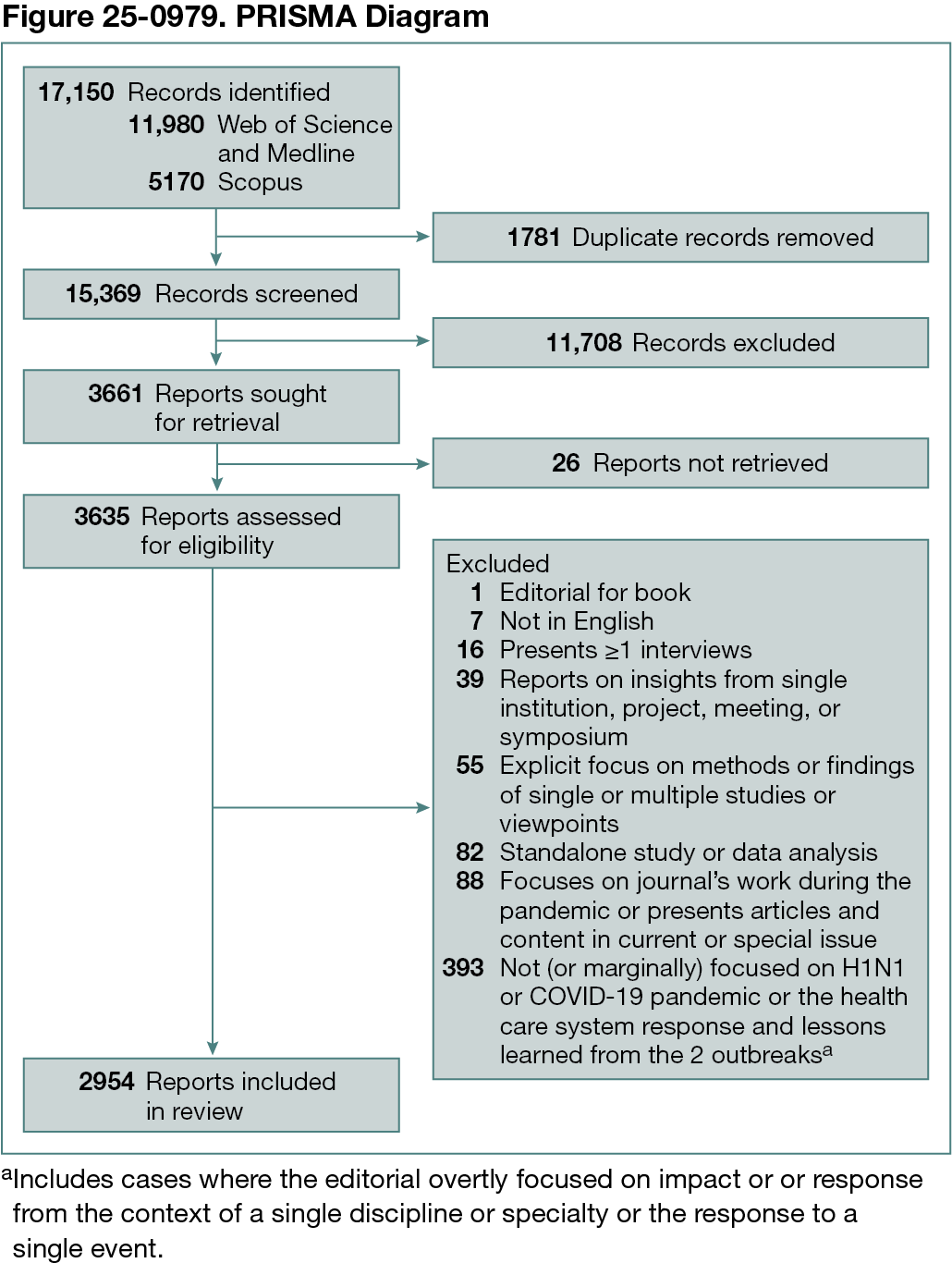
Following the screening process (Figure 25-0979), we included 2954 editorials in the final dataset. We performed a preliminary analysis of 200 editorials: 25 for the H1N1 pandemic and 175 for the COVID-19 pandemic. In contrast to our initial hypothesis, the editorials for the H1N1 pandemic had higher values for negative tone (median, 2.21 [IQR, 1.74-3.07] vs 1.69 [IQR, 1.22-2.31]; P = .007) and certitude (median, 0.39 [IQR, 0.16-0.66] vs 0.23 [IQR, 0.12-0.37]; P = .01). There were no differences in negative emotion, analytical thinking, or all-or-none thinking.
Conclusions
In this preliminary analysis, the editorials for the H1N1 pandemic contained more words connoting negative tone and certitude than those for the COVID-19 pandemic. These findings suggest that the researchers authoring these editorials expressed a more negative sentiment toward the public health response to the H1N1 pandemic and that they were seemingly more certain about their position.
References
1. Schmidt H. Pandemics and politics: analyzing the politicization and polarization of pandemic-related reporting. Newsp Res J. 2023;44(1):26-52. doi:10.1177/07395329221095850
2. Lwin MO, Lu J, Sheldenkar A, et al. Global sentiments surrounding the COVID-19 pandemic on Twitter: analysis of Twitter trends. JMIR Public Health Surveill. 2020;6(2):e19447. doi:10.2196/19447
3. Sule S, DaCosta MC, DeCou E, Gilson C, Wallace K, Goff SL. Communication of COVID-19 misinformation on social media by physicians in the US. JAMA Netw Open. 2023;6(8):e2328928. doi:10.1001/jamanetworkopen.2023.28928
1Department of Research in Biomedicine and Health, University of Split School of Medicine, Split, Croatia, luka.ursic@mefst.hr; 2Institute of Biomedical Ethics and History of Medicine, University of Zürich, Zürich, Switzerland.
Conflict of Interest Disclosures
Ana Marušić is a member of the Peer Review Congress Advisory Board but was not involved in the review or decision for this abstract. No other disclosures were reported.
Funding/Support
This study was funded by the Croatian Science Foundation under grant agreement IP-2019-04-4882 and the University of Zürich Institute of Biomedical Ethics and History of Medicine under a Stehr-Boldt fellowship given to Luka Ursić.
Role of the Funder/Sponsor
The funders had no role in the design of this study, its execution, analyses, interpretation of the data, or decision to submit results.