
An Audit and Feedback Intervention to Reduce Inappropriate Citation of Retracted Literature in the Pain and Anesthesiology Fields
Abstract
Michael C. Ferraro,1,2 Aidan G. Cashin,1,2 Amanda C. de C. Williams,3 Emma Fisher,4 Gavin Stewart,5 Christopher Eccleston,4,6,7 Neil E. O’Connell8
Objective
Continued citation of retracted literature is a threat to scientific integrity. Most authors who cite retractions are unaware the article has been withdrawn.1 While the International Committee of Medical Journal Editors (ICMJE) requires authors to check that no references in a manuscript cite retracted articles,2 few journals include this requirement in author submission guidelines.3 This study evaluated the effect of an audit and feedback intervention on retraction checking instructions in the top 20 pain and top 20 anesthesiology journal author submission guidelines.
Design
This pre-post audit and feedback intervention evaluated author submission guidelines of the top 20 pain and top 20 anesthesiology journals (according to Journal Citation Reports 2022 Impact Factor) for (1) recommendations to check manuscript references for retractions and (2) guidance on how to identify retractions. Each item was judged as yes or no (1 or 0, respectively) and given a total score out of 2. The feedback intervention was targeted at the journal editors in chief via a single email contact. Based on the journal’s score, a tailored letter was constructed (for pain and anesthesiology journals separately) including the journal score, comparison with other journals evaluated, and guidance (including a template) to implement ICMJE recommendations within author guidelines. A follow-up audit was performed at 6 months. This study was approved by University of New South Wales ethics and registered on Open Science Framework on April 2, 2024.
Results
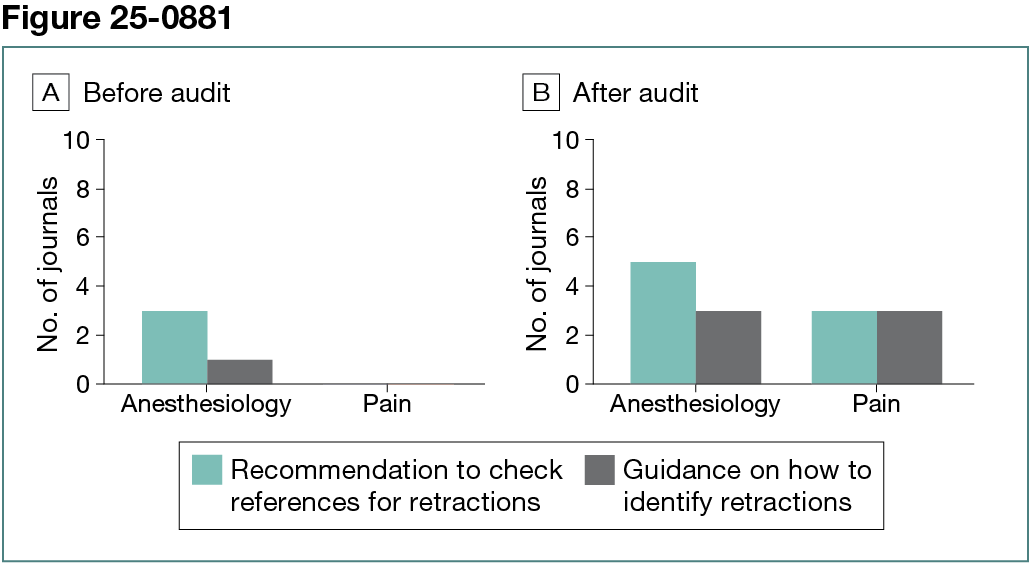
The baseline audit was performed in April 2024. The mean (SD) impact factor was 3.6 (1.5) for pain journals and 4.6 (2.6) for anesthesiology journals. Twelve of 20 pain journals and 9 of 20 anesthesiology journals were ICMJE signatories. At baseline, 0 of 20 pain journals and 3 of 20 anesthesiology journals included recommendations to check references for retractions and 0 of 20 pain journals and 1 of 20 anesthesiology journals provided guidance on how to identify retractions. At 6-month follow-up in October 2024, 3 of 20 pain journals and 5 of 20 anesthesiology journals included recommendations to check references for retractions and 3 of 20 pain journals and 3 of 20 anesthesiology journals provided guidance on how to identify retractions (Figure 25-0881). Overall, this represented an absolute score change of 25%. Correspondence with editors of 2 pain journals and incorporation of the guidance template in 1 pain journal confirmed that these changes resulted from the feedback intervention.
Conclusions
The number of pain and anesthesiology journals with author instructions to check references for retractions increased following a tailored audit and feedback intervention. However, overall uptake of the feedback was low, suggesting that more sustained editorial engagement strategies may be necessary to facilitate implementation of recommendations. Future studies should evaluate whether implementation of retraction screening recommendations into author submission guidelines reduces citation of retracted literature.
References
1. De Cassai A, Geraldini F, De Pinto S, et al. Inappropriate citation of retracted articles in anesthesiology and intensive care medicine publications. Anesthesiology. 2022;137(3):341-350. doi:10.1097/ALN.0000000000004302
2. International Committee of Medical Journal Editors. Preparing a manuscript for submission to a medical journal. Accessed January 15, 2025. https://www.icmje.org/recommendations/browse/manuscript-preparation/preparing-for-submission.html
3. Boudry C, Howard K, Mouriaux F. Poor visibility of retracted articles: a problem that should no longer be ignored. BMJ. 2023;381:e072929. doi:10.1136/bmj-2022-072929
1Centre for Pain IMPACT, Neuroscience Research Australia, Sydney, New South Wales, Australia, m.ferraro@neura.edu.au; 2School of Health Sciences, Faculty of Medicine and Health, University of New South Wales, Sydney, New South Wales, Australia; 3Research Department of Clinical, Educational and Health Psychology, University College London, London, UK; 4Centre for Pain Research, University of Bath, Bath, UK; 5School of Natural and Environmental Sciences, University of Newcastle upon Tyne, Newcastle, UK; 6Department of Health and Clinical Psychology, the University of Ghent, Ghent, Belgium; 7Department of Psychology, The University of Helsinki, Helsinki, Finland; 8Department of Health Sciences, Centre for Wellbeing Across the Lifecourse, Brunel University of London, Uxbridge, UK.
Conflict of Interest Disclosures
Aidan G. Cashin, Amanda C. de C. Williams, Emma Fisher, and Christopher Eccleston are editorial board members for 2 of the pain journals (PAIN, Journal of Pain) included in this audit. No other disclosures were reported.
Funding/Support
No specific funding was received for this project. Michael C. Ferraro was supported by an Australian Government Research Training Program PhD scholarship and a Neuroscience Research Australia top-up scholarship.
Role of the Funder/Sponsor
The sponsor, Neuroscience Research Australia, had no role in the design and conduct of the study; collection, management, analysis, and interpretation of the data; and decision to submit the manuscript.
Additional Information
This study was registered on Open Science Framework at https://osf.io/gbkjy/.