
An Analysis of Equity, Diversity, and Inclusion Concerns From JAMA Network Peer Reviewers
Abstract
Michael O. Mensah,1 Anand R. Habib,2 Jacob Kendall-Taylor,3 Mya Roberson,4 Kanade Shinkai,4 Annette Flanagin,3 Preeti Malani3
Objective
In March 2023, the JAMA Network invited peer reviewers to check a box when concerned about elements of equity, diversity, and inclusion (EDI) in manuscripts, and to explain such concerns in confidential comments to the editor. We examined peer reviewers’ use of the EDI concerns checkbox and categorized concerns described in confidential comments.
Design
In this cross-sectional, mixed-methods analysis, we initially examined all reviewed manuscripts for 13 JAMA Network journals between March 28, 2023, and December 31, 2024, and determined counts and percentages of reviews that utilized an EDI concerns checkbox. As a case study, we then used rigorous and accelerated data reduction (RADaR) to analyze deidentified, confidential reviewer comments for JAMA Dermatology manuscripts. RADaR develops all-inclusive data tables, then iteratively reduces those tables until only research question–relevant data remain.1 Two former JAMA editorial fellows independently classified confidential comments as either relevant or irrelevant to EDI and then inductively coded comments. The coders agreed on which code(s) best described each comment and then distilled prominent categories among all comments. This study was deemed exempt by Yale School of Medicine’s institutional review board and follows STROBE and SRQR guidelines.
Results
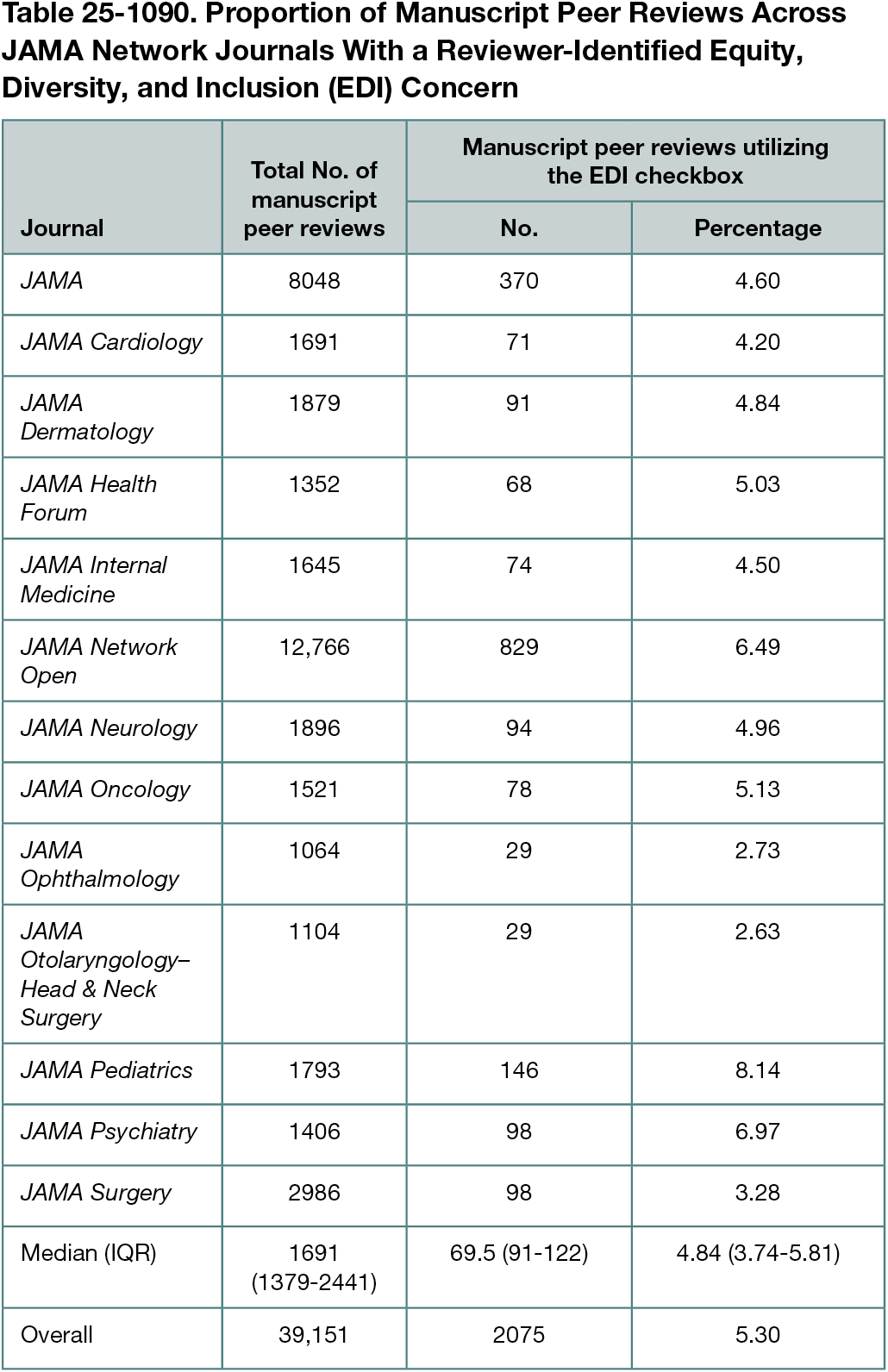
Among 39,151 reviews across all JAMA Network journals, 5.3% (2075 of 39,151) utilized the EDI concerns checkbox, including 5.5% (1897 of 34,542) of research manuscript reviews. JAMA Otolaryngology reviews utilized the EDI checkbox least often (2.63% [29 of 1104] overall; 2.7% [26 of 948] of research manuscripts). JAMA Pediatrics reviews utilized the EDI checkbox most often (8.14% [146 of 1793]; 8.0% [126 of 1583] of research manuscripts). JAMA Dermatology reviews utilized the EDI checkbox at the median frequency among all JAMA Network journals (4.84% [91 of 1879]; 5.4% [78 of 1439] of research manuscripts) (Table 25-1090). Among JAMA Dermatology reviews utilizing the EDI checkbox, 34.1% (31 of 91) had confidential comments relevant to EDI, 50.5% (46 of 91) were irrelevant to EDI, and 15.4% (14 of 91) had no comment. Regarding EDI-relevant confidential comments, categories of responses included lack of clarity regarding race and ethnicity categories (48.4% [15]), statistical or methodological concerns (16.1% [5]), skin tone representation (9.7% [3]), ambiguity in language around demographic identifiers (9.7% [3]), and inappropriate use of gender ascribed by observers (6.5% [2]).
Conclusions
Overall, the EDI concerns checkbox was infrequently used across the JAMA Network journals. Among JAMA Dermatology reviews using the EDI concerns checkbox, less than half had confidential comments relevant to EDI, perhaps because instructions to reviewers did not define EDI concerns. Prominent categories among EDI-relevant comments included concerns about proper usage of race and ethnicity categories, absence of photos depicting dermatologic conditions in darker skin tones, and use of inclusive language regarding sex and gender, consistent with equity issues previously noted by the American Academy of Dermatology.2 Future work could explore ways of systematically capturing EDI concerns from reviewers and their eventual influence on manuscripts accepted for publication.
References
1. Watkins DC. Rapid and rigorous qualitative data analysis: the “RADaR” technique for applied research. Int J Qualitative Methods. 2017;16(1):1609406917712131. doi:10.1177/1609406917712131
2. American Academy of Dermatology Association. Diversity and the academy. Accessed June 8, 2025. https://www.aad.org/member/career/diversity
1Department of Psychiatry, Yale School of Medicine, New Haven, CT, US, michael.mensah@yale.edu; 2National Clinician Scholars Program, Yale School of Medicine, New Haven, CT, US; 3JAMA and the JAMA Network, Chicago, IL, US; 4JAMA Dermatology, Chicago, IL, US.
Conflict of Interest Disclosures
Michael O. Mensah is co-editor of the Race and Mental Health Equity column in Psychiatric Services, unrelated to this work. Mya Roberson receives consulting fees from the National Committee for Quality Assurance outside the scope of the submitted work. Annette Flanagin is a member of the Peer Review Congress Advisory Board but was not involved in the review or decision for this abstract.