
Academic Institutional Affiliations and Gender of Authors, Editorial Board Members, and Editors of Journals
Abstract
Ulrike K. Müller,1 M. Janneke Schwaner,2 Ksenia Keplinger2
Objective
Despite decades of diversity initiatives, inequality persists, including in academic publishing. Promising trends remain weak when intersectionality is considered.1,2 Inspired by the concept of intersectionality, we hypothesize that relying solely on gender as an indicator underestimates inequality, as decades of tokenistic inclusion measures have masked the true extent of inequality. The central idea of this study requires us to go beyond direct equity indicators, such as gender, race, and geographic location, and to identify indirect indicators. We predict that indirect indicators of inequality that correlate with gender due to intersectionality (eg, type of institution, as the proportion of women faculty is lower at research-intensive institutions3) will show higher levels of inequality, with more extreme disparities at higher rungs of the academic power ladder.
Design
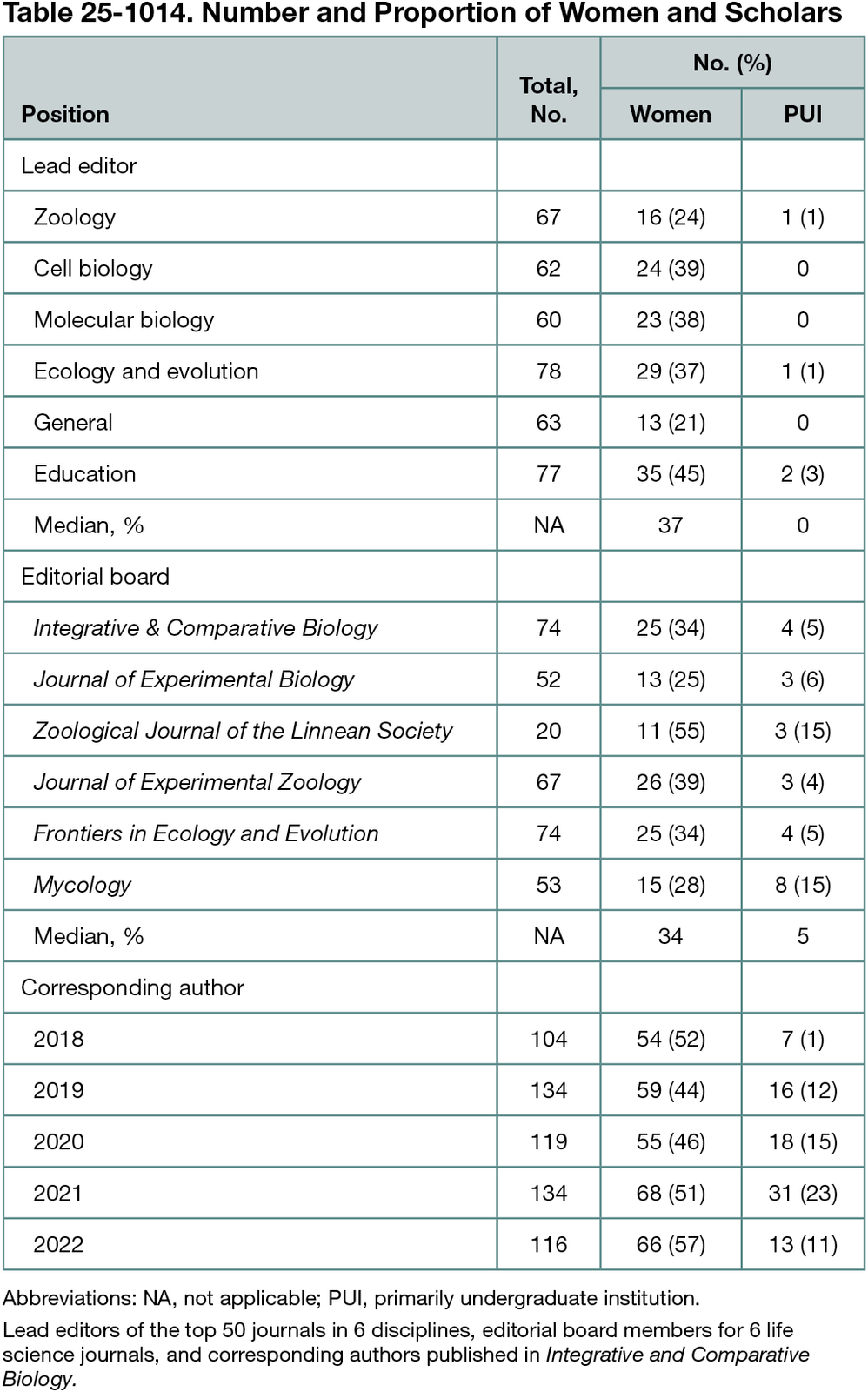
In this cross-sectional study, we quantified inequality predicted by gender vs type of institution by collecting data from 50 top-ranked journals (SCImago ranking) for 6 academic fields (Table 25-1014) on lead editors, on editorial boards for 5 of those journals, on corresponding authors for 1 journal, and the editorial board for 1 journal from 1979 to 2022. All data were accessed in 2022. We determined gender from pronouns used in self-authored or self-edited documents whenever possible, such as editorial biographical sketches, and otherwise used text written by authors with a high likelihood of knowing correct pronouns, such as acknowledgments. When collecting data on lead editors, we excluded publications led by large subject-specific editorial teams.
Results
This study included 407 lead editors, 340 editorial board members, and 607 corresponding authors. Overall, women accounted for 51% of corresponding authors, 34% of editorial board members, and 37% of lead editors. Between 1979 and 2023, the proportion of women editors increased steadily from a median of 10% in the 1980s to more than 50% in the 2020s. In contrast, the proportion of PUI editors remained largely flat, with a median near 10%, only increasing in the 2020s under the tenure of a PUI lead editor. Inequality was higher for type of institution. Although more US faculty worked at primarily undergraduate institutions (PUIs) than PhD-granting institutions, only 12% of corresponding authors, 5% of editorial board members, and less than 1% of editors in chief worked at PUIs.
Conclusions
The observed trends are consistent with our central idea—indirect indicators of inequality that reflect intersectionality, such as type of institution, reveal more severe inequality in academic publishing than direct inequality indicators, such as gender.
References
1. Memon AR, Ahmed I, Ghaffar N, Ahmed K, Sadiq I. Where are female editors from low-income and middle-income countries? a comprehensive assessment of gender, geographical distribution and country’s income group of editorial boards of top-ranked rehabilitation and sports science journals. Br J Sports Med. 2022;56(8):458-468. doi:0.1136/bjsports-2021-105042
2. Bates DC, Borland E. Fitting in and stalling out: collegiality, mentoring, and role strain among professors in the sciences at a primarily undergraduate institution. Polymath. 2014;4(2):50-68.
3. Curtis JW. Faculty gender equity indicators 2021: data report. Accessed July 16, 2025. https://mountainscholar.org/bitstreams/78250ae2-8a5c-4bc0-b43d-4417d53adba9/download
1Fresno State University, Fresno, CA, US, umuller@csufresno.edu; 2Max Planck Institute for Intelligent Systems, Stuttgart, Germany.
Conflicts of Interest Disclosures
Ulrike K. Müller is the editor in chief of Integrative and Comparative Biology, a journal included in the dataset analyzed for this study. No other disclosures were reported.